
KOWON Blog
My nose looks bigger in selfies. Is it really large?
A larger-looking nose in a selfie does not establish its actual size. Learn about close camera distance, rear-camera limitations, photo comparisons and consultation preparation.
Key points
- Close selfies can make the nose look proportionally larger. This differs from the nose actually becoming larger.
- Front versus rear camera is not enough to judge the image. Check distance, angle and any shape-changing edits as well.
- One photograph cannot establish a need for surgery. Other views, your actual condition and the change you want all matter.
A nose that looks large in a selfie does not, by itself, mean your nose is actually large or that you need surgery. When a camera is close to your face, the projecting nose can look larger relative to other facial features. Start by separating the conditions of the photograph from the actual shape of your nose.
Your nasal tip or nostrils may bother you in a phone photo even when they look fine in the mirror. That difference does not require you to declare one view your only ‘real face’ and the other wrong. First check the distance and angle used for the photograph.
01
Why can a close photograph make the nose look larger?
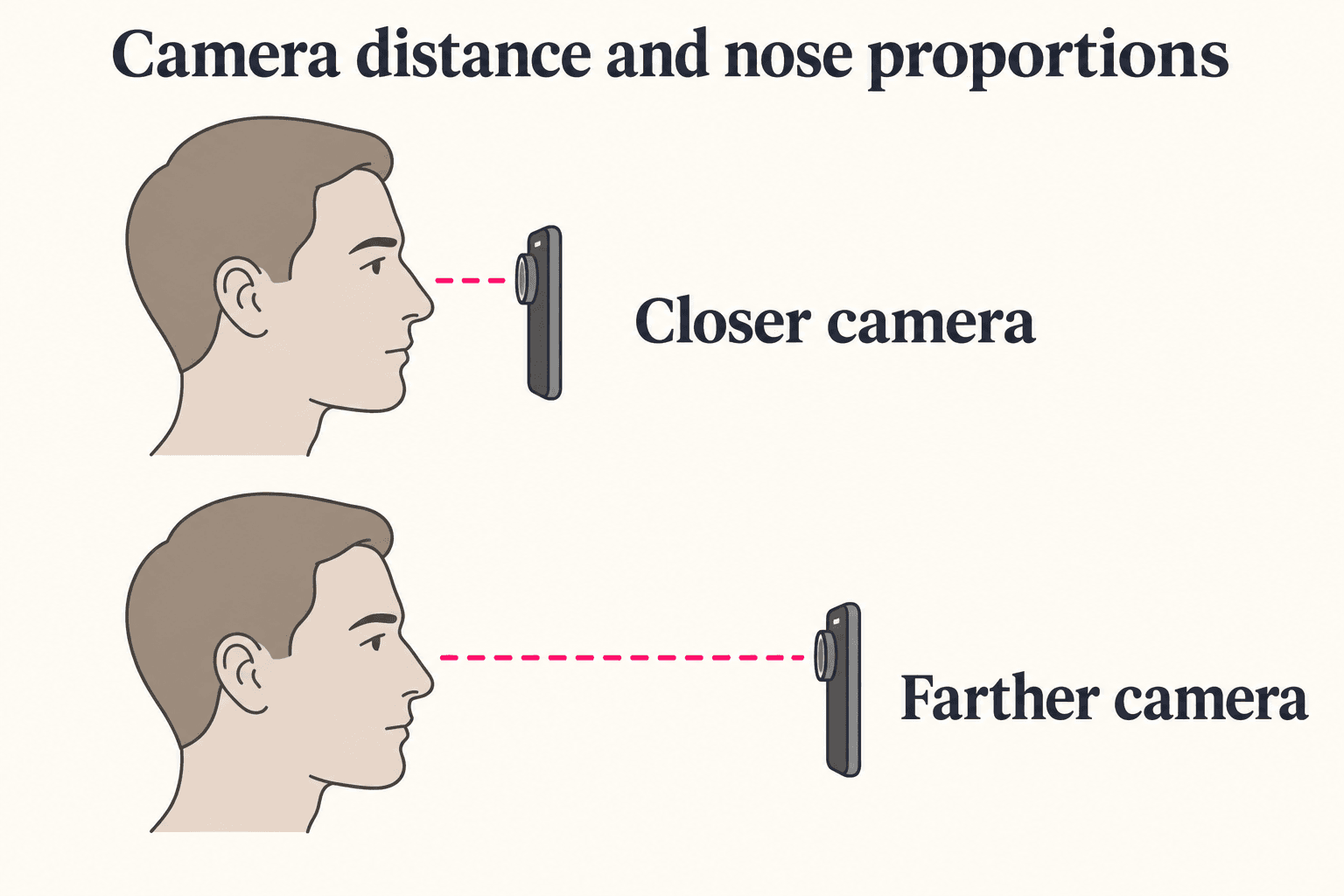
Facial features are not all the same distance from a camera. The nose projects in front of the cheeks and ears, so a closer camera makes that distance difference more influential in the photographed proportions. This is a perspective effect: nearer parts appear relatively larger.
A 2018 study in JAMA Facial Plastic Surgery used a mathematical model based on average facial measurements to describe how camera distance changes the apparent proportion of nasal width. It was not a test of an individual's actual nose size or need for surgery.
A close selfie that fills the frame can therefore look different from a photograph taken farther away. The illustration below changes only the distance between the face and camera, keeping the nose shape the same. It does not depict the amount of change in any individual.
02
Does a wide-looking nose in a photo mean a bulbous tip or wide nostrils?
That impression alone cannot establish a bulbous tip or wide nostrils. First distinguish whether the photo emphasizes the nose's proportions or the same area also concerns you in everyday life.
‘My nose looks large’ can mean different things. A rounded tip, wide nostril base and a nose that projects strongly in profile raise different questions. Identifying the specific area makes it easier to discuss the impression in a photo separately from the change you actually want.
If the same area appears in photographs taken under different conditions, that is information to bring to a consultation. It still does not determine a correction method. The photographed appearance needs to be considered alongside the structure assessed during an examination.
03
Does using the rear camera make a photo match real life?
Switching to the rear camera alone cannot guarantee that a photo matches your appearance in real life. Distance, the lens and photography settings influence the proportions as well as the camera type.
A study published in The Laryngoscope in 2024 photographed 12 people using a smartphone and a full-frame camera to compare distances and lens conditions. It observed changes in facial proportions at close distances. Results from this small study's particular equipment and conditions cannot be applied as identical numbers to every phone or person.
There is also no need to treat one phone zoom setting as the standard for your ‘real appearance’. Cropping and enlarging a photograph taken from the same position does not change its original perspective relationships. Before judging camera names or zoom numbers, check whether the actual camera distance differed.
04
Which conditions should you check when comparing photographs?
Start with what changed besides the nose itself. The table offers things to check before turning different photographic impressions directly into a concern about surgery. It is not a way to diagnose your nose at home.
| Condition | What to compare | Limit when interpreting it |
|---|---|---|
| Camera distance | Whether the camera was close to the face or farther away | Matching image sizes does not remove the original perspective difference. |
| Camera height and head direction | A frontal, high or low view, and whether the head turned | Different angles show different surfaces of the nose. |
| Expression | A relaxed expression versus a smile | Different expressions make it difficult to compare the resting shape. |
| Lighting and edits | Shadow direction, brightness and changes to facial shape | An edited contour should not be treated as the actual structure. |
Consider using a timer or asking someone to help you create more camera distance. The aim is to prepare several views under reasonably similar conditions, rather than declare a single photograph taken at one distance the ‘correct’ image.
05
How should you prepare consultation photographs?
Rather than choosing only the most flattering images, show the situations in which the area concerns you. Follow the clinic's photography instructions first if it provides them.
- 01Prepare original photographs without edits that change facial shape.
- 02Include requested views, such as frontal and profile photographs, without making distance or head position markedly inconsistent.
- 03Go beyond ‘my nose looks big’ and note whether the tip, nostril base or profile concerns you.
- 04Explain whether this happens only in photos or is also a concern in the mirror and everyday life.
- 05Mention previous nose surgery, filler or thread procedures, and discomfort such as nasal obstruction.
Photographs communicate a concern. They should not, by themselves, establish whether a desired change is possible or determine materials in advance. The rhinoplasty consultation guide can help you prepare questions.
06
What does a consultation consider besides photographs?
A consultation considers your current condition, desired change, breathing discomfort and previous treatment history alongside photographic impressions. The American Society of Plastic Surgeons' consultation guidance includes appearance and breathing goals, previous treatments and operations, facial examination and measurements, likely outcomes and risks.
The starting point is to distinguish the influence of photography from the part you actually want to change, rather than simply reduce whichever area stands out in a selfie. You can then discuss possibilities and limits for your individual condition. When preparing, see the video consultation information for photography guidance.
Frequently asked questions
Answers to common questions patients ask before a consultation.
Not necessarily. A short camera distance can make the nose look proportionally larger within the face. Consider the photography conditions, other views and your actual condition together.
The rear camera alone does not establish that. Distance, angle, the lens and edits can change the impression. Several views under similar conditions are more useful than one photograph from a particular camera.
Cropping and enlarging a photo taken from the same position does not change its original perspective relationships. Distinguish the size of the face on the screen from the actual distance between the camera and face.
It is better not to determine a need for surgery or its scope from a selfie alone. Use it to explain the area that concerns you, then discuss your actual condition, desired change, breathing function and the risks and limits of possible methods during a consultation.
Responses to treatment and recovery progress vary by individual. Outcomes and side effects vary from person to person. Bleeding, infection, swelling and asymmetry may occur. Please consult our medical team before making a decision.
Consultation