
KEY DOCTOR
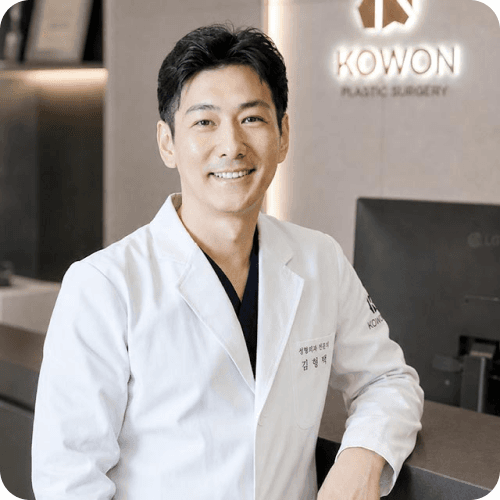
Dr. Kim Hyung-taek
Not the nose that is in fashion — the nose that suits you. 24 years on nose surgery alone; the consultation, the operation and the aftercare are all mine.
Surgery isn't something you do because you can —
you do it when it is needed.
About half the people who come in for a consultation I quietly send home. “Your nose is genuinely lovely as it is — I don't think you need this.” To me that is the most honest consultation there is. If I judge it truly unnecessary, I don't recommend it. I sent two people home again today, and I think I can hear my staff sighing a little louder than usual.
— Kim Hyung-taek, Director, KOWON Plastic Surgery
- Years in nose surgery
- 24yrs
- Operations to date
- 10,000+cases
Profile
Kim Hyung-taekDirector, KOWON Plastic Surgery · Board-certified plastic surgeon
After training at Samsung Medical Center, I spent four years under Dr. Oh Young-hwan — a well-known name in rhinoplasty — leading the autologous rib cartilage centre and handling those cases myself. Since then I have looked at nothing but noses. My party trick is harvesting rib cartilage in fifteen minutes; my real strength, I think, is listening. I read and I draw — I started drawing in my first year of primary school and I am still learning.
Current post & career
- Board-certified plastic surgeon
- Director, KOWON Plastic Surgery
- Adjunct Professor of Plastic Surgery, Sungkyunkwan University School of Medicine
- Residency in Plastic Surgery, Samsung Medical Center, Sungkyunkwan University
- Former Director & Head of the Autologous Rib Cartilage Centre, O&Young Plastic Surgery
Society memberships
- Korean Society of Plastic and Reconstructive Surgeons
- Korean Society for Aesthetic Plastic Surgery
- Korean Cleft Palate-Craniofacial Association
- Korean Association of Plastic Surgeons
- International Confederation for Plastic Surgery (IPRAS)
- Rhinoplasty Research Group, Korean Society of Plastic and Reconstructive Surgeons
- Blepharoplasty Research Group, Korean Society of Plastic and Reconstructive Surgeons
Academic archive
A career built over time,
preserved in its records
Original records of Dr. Kim's academic work in rhinoplasty and aesthetic surgery since 2006, together with his current teaching appointment.
Adjunct Professor, Sungkyunkwan University School of Medicine
Appointment 2026.03 — 2028.02
His current work brings years of clinical experience in plastic surgery into medical education.
Academic activity records
2006—2019 · Select a record to view the original in full.
Honest Standards
Nose surgery — the honest criteria.
01
I talk people out of surgery more often now
There are noses that are better left alone — far more of them than you would think. After more than twenty years doing nothing but nose surgery, I find myself talking people out of it more, not less. Surgery isn't something you do because you can; doing it when it is actually needed matters more.
02
The result is decided at the first consultation
People who come in for revision surgery say the same thing over and over: “this isn't the nose I had in mind.” What matters is not how much height you add, but the process of setting the plan — on what basis, what to preserve and what to reduce — right at the start.
03
I look at the face, not just the nose
Whenever I post a before-and-after, someone asks “how many millimetres was that?” The millimetre count of the implant is not really the point. The same 4mm can look natural or leave the nose floating on its own, depending on the height of the forehead and brow ridge and on the glabella.
In the Consulting Room
Conversations we have often in the consulting room, in the doctor's own words.
“If I have surgery, will I look like a celebrity?”
I take a photograph and show you the change in real time. We discuss your current nasolabial angle, the balance between nose and forehead, the ratio of bridge to tip, and a design that fits how you actually come across. It is better to see the change you have only imagined and then decide.
“Can't I just have a small, simple tip correction?”
For some noses, yes. But if the bridge is left alone and only the tip is raised, the line from bridge to tip often fails to run naturally. Unlike other areas, the nose is a chain of linked elements that together make the result.
“I'm in my forties — is a first operation too late?”
Age is not what decides whether to operate. There are people in their twenties I advise against it, and people in their fifties who get an excellent result. What matters is not age but an appropriate plan.
“Is revision surgery inevitable after ten years?”
No. Most patients who come back ten or twenty years later — sometimes with their daughter — have no pain, no inflammation and the same shape. The real signals for revision are pain at rest, redness and swelling from inflammation, and a shape that has bent or lifted.
“What if it goes wrong?”
You don't have to decide in a hurry. Why this operation is right for your nose, and why this material has to be used — I would like you to understand at least those two things before you decide.
What I gave up to keep this
Instead of raising the number of operations, I protected the time spent on each one.
Two a day
Surgery is a battle of concentration
People often tell me it is hard to get an appointment. That is because of the two-operations-a-day rule. I believe the best result comes when I can give one person my full attention.
One surgeon
The same person, start to finish
The simulation, the consultation, the operation and the aftercare are all done by me. If something comes up, the person who looks at it is the one who knows your nose. The director's reputation is the clinic's reputation.
CCTV
Reassurance comes from showing
The patient is nervous, but so is the family waiting outside. From the family waiting room you can watch the operating-room CCTV in real time. Reassurance starts with showing rather than telling.
Noses that still make me tense, 24 years in
- Very thin skin
- Heavy adhesion from previous surgery
- Threads or foreign material to remove
- Inflammation or fragile mucosa
The more complicated the nose, the more it helps to have handled a great many of them.
Main Surgeries
Functional problems such as a deviated septum and aesthetic correction are not treated as separate matters — a board-certified plastic surgeon judges them together.
Written by the doctor himself
“They're short pieces, but hearing that one of them earned somebody's trust really does keep me going.” From common misconceptions to what actually happens in the consulting room, Dr. Kim writes it himself.