
KOWON Blog
If silicone looks sunken on CT after hump surgery — why when the outside looks fine
A case where the silicone's end looks sunken inward on CT after hump surgery, yet nothing looks wrong outside — why this happens, what problem remains if only the silicone is removed, and the reinforcement direction, organized from a Jisik iN answer.

Key points
- If the silicone's end looks sunken inward on CT, sustained force on the silicone's front part may have pushed it into the nose — a possibility to consider.
- Even if no sunken part is visible outside, the tip has likely lowered compared to right after surgery.
- If the septum sank and the silicone went in with it, removing only the silicone leaves the nose looking low — reinforcement may need surgery strengthening the septum. Accurate judgment requires direct examination.
"I got a CT and was told the silicone isn't straight — it's bent inward. But looking from outside, there's no problem at all. Why is this?"
This article is based on an actual question from someone who heard that the silicone looked sunken inward on a lateral CT after hump surgery. Why the silicone went inward, and whether there's a way to compensate if removed — the Jisik iN question and answer are organized here.
01
What situation produced this question?
The questioner's situation organizes like this.
- She'd been a hump nose before surgery — silicone was inserted starting 2mm from the glabella, gradually thickening toward the tip.
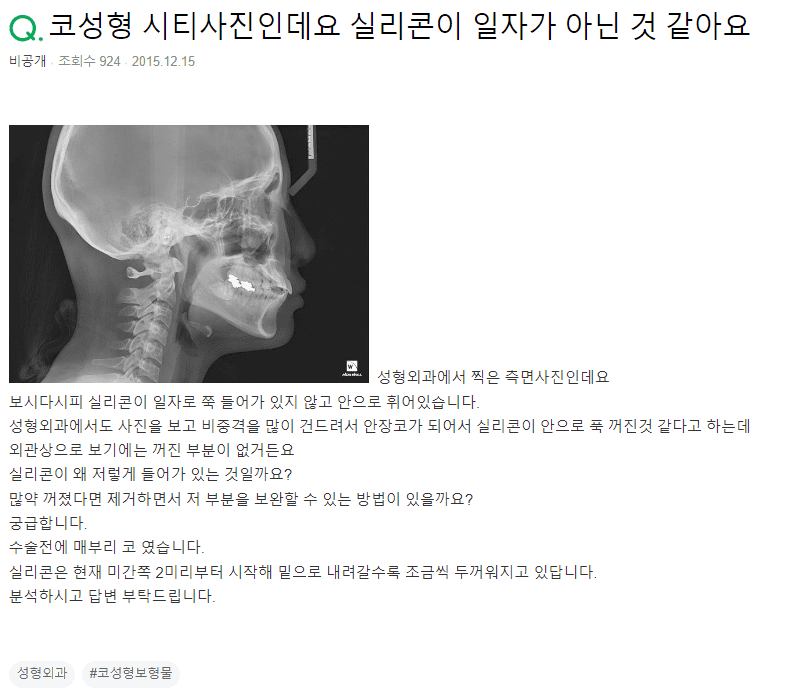
- On a lateral CT taken at the clinic, the silicone wasn't straight — it was bent inward.
- The clinic explained that the septum had been heavily worked on, producing a saddle nose that let the silicone sink inward.
- Yet nothing looked wrong on the outside at present.
The questions were two — why the silicone went inward, and whether there's a way to compensate if it's removed.
02
Why does silicone go inward when the outside looks fine?
On the CT image, the state appeared as the silicone's end settled inward.
Not certain, but it can be presumed that sustained force applied to the silicone's front part pushed it into the nose. And even if no sunken part is visible outside, the tip has likely lowered compared to right after surgery — meaning no clear change in appearance doesn't mean no change in structure.
Still, this is an inference from the CT image alone. The exact cause can only be stated by directly seeing what surgery was performed and the nose's current state. Answers based on imaging alone are for reference — you must consult the attending physician at the hospital where it was taken.
03
Is there a way to compensate if the silicone is removed?
The fork in the road here is the septum's state.
| Situation | What's the problem | Reinforcement direction |
|---|---|---|
| If it was a surgery using the septum | The septum may have settled, taking the silicone inward with it | Surgery strengthening the septum |
| If only the silicone is removed | The nose ends up looking low | Removal alone is insufficient — structural reinforcement must accompany |
In short, if the septum settled and the silicone went in with it, removing only the silicone leaves the nose looking low — so for compensation, surgery strengthening the septum would likely be needed.
The general criteria for cases needing implant removal and structural reinforcement judged together can be seen further in the revision surgery guide, and the approach building structure with one's own tissue instead of implants in the autologous tissue surgery guide.
04
Summary — what shows and what's inside can differ
Even if nothing looks wrong outside, CT can show the silicone settled inward. Possibilities include sustained force on the silicone's front or the septum settling and taking it in — and in the latter case, removing only the silicone leaves the nose looking low, so septal strengthening must be judged together. Either way, the starting point is the same — getting the nose's current state confirmed directly.
If you're agonizing over a similar situation, you can inquire about your current state in a 1:1 video consultation.
Frequently asked questions
Answers to common questions patients ask before a consultation.
Even if no sunken part is visible outside, if the silicone has settled on CT, the tip may be lower than right after surgery. Whether to leave it or compensate can only be judged by directly confirming what surgery was performed and the nose's current state — so consulting the attending physician comes first.
If the septum settled and the silicone went in with it, removing only the silicone leaves the nose looking low. So in such cases, surgery strengthening the septum is viewed as needed alongside removal.
No. From CT images you can confirm the silicone has settled and infer the cause — but accurate cause judgment is only possible by directly seeing the surgery performed and the nose's current state. Image-based answers should be used for reference only.
Responses to treatment and recovery progress vary by individual. Outcomes and side effects vary from person to person. Bleeding, infection, swelling and asymmetry may occur. Please consult our medical team before making a decision.
Consultation