

Hello, this is Hyung-taek Kim, director of KOWON Plastic Surgery.
The case I will discuss this time involved a patient whose nasal bridge was low, resulting in a lack of centrality for the nose on the face, and whose bulbous tip was prominent, making the nasal tip appear wide and spread out. In addition, the alar base / nostril wing was drooping downward, and the columella was also short and low, which made the alar base / nostril wing stand out even more.
In such a structure, simply raising the nasal bridge or refining only the nasal tip may not be sufficient for overall improvement.
When I perform surgery, I focus on balancing the lower part of the nose by not looking at the nasal tip, alar base / nostril wing, and columella separately, but rather by considering how they influence each other.
First, the nasal bridge was raised to an appropriate height considering the overall facial proportions, so that the nose could serve as the center of the face. For the nasal tip, I combined nasal tip cartilage repositioning, nasal tip cartilage suturing, and removal of soft tissue at the nasal tip to refine the areas that were spread out to the sides, creating a sharper and cleaner shape.
Additionally, a support was added between the nasal tip cartilages to reinforce the structural strength of the nasal tip. This process secures support to reduce the risk of the nasal tip spreading again after surgery and to maintain the created shape stably.
As for the columella, rather than correcting only the part that appeared short and flat, I adjusted the positional relationship between the nasal tip and alar base / nostril wing while reinforcing the support structure. By balancing with the surrounding structures in this way, it is possible to create a natural shape without overemphasizing only the nasal tip.
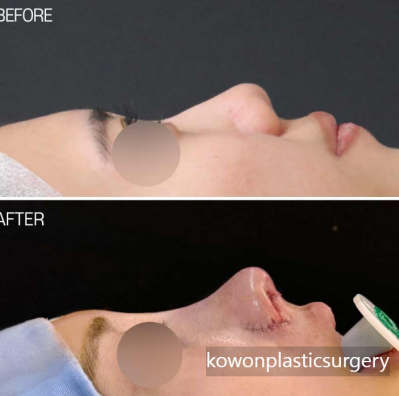
These before and after photos are used with the patient's consent.
In particular, the alar base / nostril wing, which was drooping downward, was corrected together with consideration of its relationship to the columella. By performing alar base lift to address the drooping area, the proportion between the nasal tip and alar base / nostril wing was balanced, which helped reduce the previously stuffy appearance of the nose overall.
The wide alar base / nostril wing was reduced in width on both sides using incisional alar reduction. Because this method directly excises skin and soft tissue, it can help more clearly reduce the width of the alar base / nostril wing. This change is important when evaluating the overall shape of the alar base / nostril wing, and when comparing before and after alar reduction surgery, it is important to check not only the change in width but also the proportion with the nasal tip.
However, since this method involves incisions, it is necessary to carefully monitor the scars and swelling at the incision site in the early postoperative period. Because skin characteristics and recovery speed vary from person to person, it is necessary to manage while sufficiently monitoring the progress rather than setting a fixed period.
As a result, the centrality of the nose, which previously appeared low and wide, was restored, and the positions and proportions of the nasal tip, alar base / nostril wing, and columella were harmoniously arranged. When I explain before and after alar reduction surgery, I look not only at the size of the alar base / nostril wing but also at how the overall balance of the nose has changed. In this case as well, by harmonizing the overall structure, it led to a clearer and more refined impression.
[Other reference cases]
This is a case of a male patient with a low nasal bridge, a wide and spread-out nasal tip, and flared alar base / nostril wing, all presenting together as a bulbous tip. In particular, the nasal bridge was low from the glabella and the skin was thick, making the nose appear even wider and duller from the front.
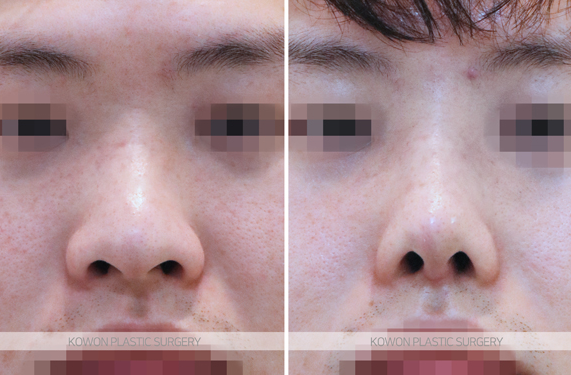
These before and after photos are used with the patient's consent.
For the surgery, silicone was used to augment the nasal bridge, and septal cartilage and ear cartilage were used to reinforce the length and support of the nasal tip. Additionally, depressor septi nasi muscle removal and mild dorsal hump correction were performed, and nasal tip cartilage suturing and non-incisional alar reduction were combined to refine the wide nasal tip and alar base / nostril wing.
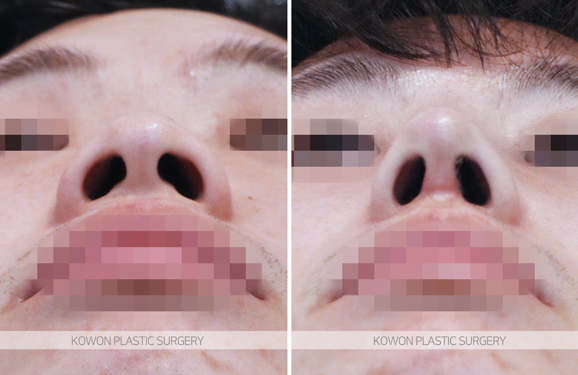
These before and after photos are used with the patient's consent.
After surgery, the previously flared nasal tip appeared more defined when viewed from below, and the wide and spread-out nasal contour was refined from the front, confirming a clearer and more balanced impression in the before and after alar reduction surgery results. In particular, for a short bulbous tip with thick skin, it was important to provide sufficient length and firm support to the nasal tip.
[In summary]
A bulbous tip cannot be corrected to the desired shape simply by reducing the size of the nasal tip or alar base / nostril wing. It is important to consider the overall structure, from the height of the nasal bridge to the length and support of the nasal tip, as well as the positions of the columella and alar base / nostril wing.
Especially, even if the alar base / nostril wing appears wide, it should not be reduced excessively without considering changes to the nasal tip and nasal bridge; the overall proportions must be balanced. When comparing before and after alar reduction surgery, it is better to check not only how much the width of the alar base / nostril wing has decreased, but also how harmoniously the entire nose has been refined.
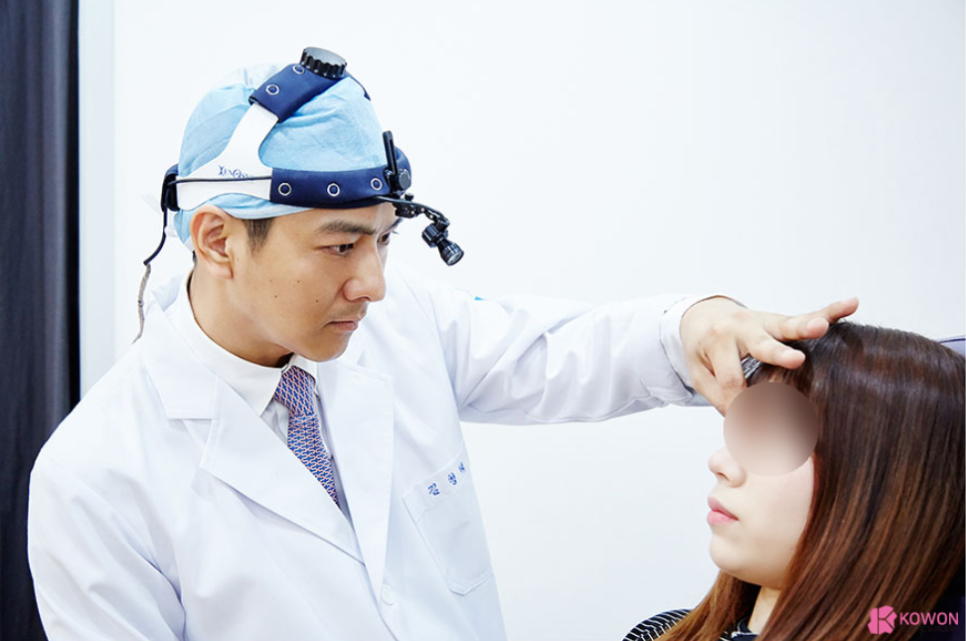
From consultation to surgery, I carefully assess each nasal structure and skin characteristic, and I believe it is important to combine necessary procedures to create a clear change without overdoing it. At KOWON Plastic Surgery, based on this principle, we do not apply only one method but establish a surgical plan tailored to the individual's structure.
Ultimately, what is important is that even if patients share the same concern of a bulbous tip, the same method is not applied to everyone. Accurately understanding the structure and proportions of the nose and finding the appropriate direction is the key to achieving satisfactory results. KOWON Plastic Surgery will continue to perform surgeries that consider both natural harmony and stable structure.
More surgical records

KOWON Plastic Surgery Clinic
2nd Floor, KBL Center, 110 Dosan-daero, Gangnam-gu, Seoul
This procedure/surgery may cause side effects such as bleeding, infection, swelling, or asymmetry depending on the individual. For accurate information, please consult with medical professionals before making a decision.
— Dr. Hyung-taek Kim, KOWON Plastic Surgery