
KOWON Blog
4 criteria to check before choosing a rhinoplasty clinic — design·material·function·system
Four things to check when looking for a rhinoplasty clinic near Garosu-gil — design that considers facial proportion, material selection that considers complication risk, an approach treating function and cosmetics together, and surgical experience plus safety systems.
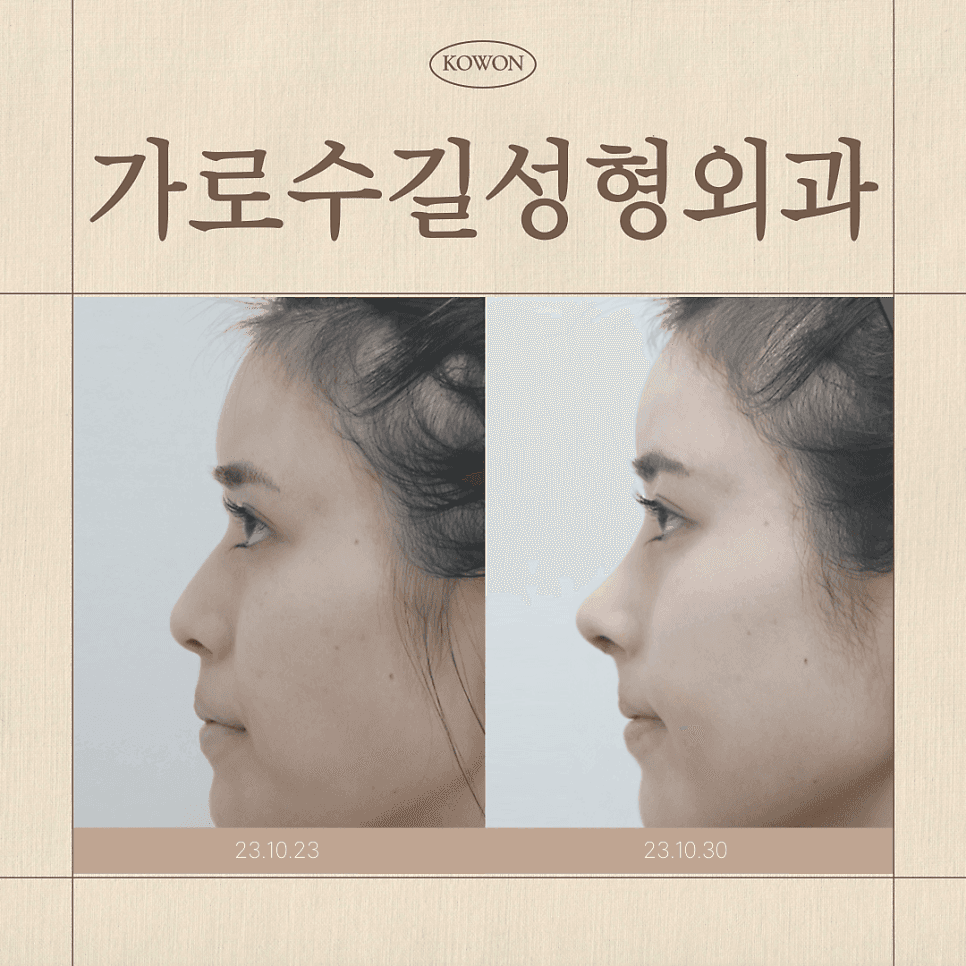
Key points
- Rather than chasing a specific celebrity's shape, set criteria that consider your facial skeleton and airway function — that's how you lower the chance of revision.
- Four criteria to check — design that considers facial proportion, material selection weighing complication possibility, an approach treating function and cosmetics together, surgical experience and safety systems.
- If you already have rhinitis·congestion, also check whether an integrated approach that fixes internal structure alongside cosmetic surgery is needed.
"I want to look like this celebrity's photo — can a nose that suits me come out of it?"
Searching for information while weighing rhinoplasty near Garosu-gil, worry about complications is likely as big as the reviews. Rather than simply chasing a specific shape, you need clear criteria that consider your facial skeleton and airway function — that's what lowers revision risk.
Drawing on 20+ years focused on the nose, this article organizes four criteria to check before choosing a rhinoplasty clinic.
01
What should nose design be judged by?
Rhinoplasty's flow is moving away from uniform height-raising of the past toward naturalness that blends organically with your face. For design, objective data analysis should precede reliance on the doctor's subjective sense.
- Custom line design — direction splits by the impression you want: a straight-curved line, or a linear flow emphasizing dimension.
- Scientific analysis system — check whether design is proposed via 3D-CT etc., analyzing bone thickness and cartilage state at 0.1mm units.
This becomes the first criterion for removing artificiality and making naturalness that looks like your own nose. Watching how such design criteria are explained in consultation is also an important judgment factor when choosing a hospital.
02
Why should material selection be viewed through complications?
Post-rhinoplasty complications like inflammation or show-through can be largely prevented just by setting material-selection principles well. Especially with thin skin or aversion to implants, it's good to look from the 'autologous-tissue implant' concept as a benchmark.
Recently, a method using finely processed autologous rib cartilage is being raised as one alternative — KOWON has applied the 'RIBFIT™' method, which finely processes autologous rib cartilage and compresses it into a custom implant form, since before this approach became widespread.
- Warping considered — unlike solid cartilage, particle form carries almost no warping risk, and can achieve sleek shapes like silicone.
- High biocompatibility — using 100% autologous tissue, it's relatively free from contracture or rejection caused by artificial material.
How the RIBFIT™ method proceeds is detailed in the RIBFIT™ autologous rib cartilage guide.
03
Why should function and cosmetics be viewed together?
As important as external beauty is the nose's internal function. If you suffer rhinitis or congestion, an integrated approach fixing internal structure alongside cosmetic surgery is needed.
Correcting elements that obstruct the airway — deviated septum, nasal valve stenosis — together can bring functional improvement. When disease treatment is included, insurance coverage varies by your plan and diagnosis. Checking whether a hospital has a collaboration system handling cosmetics and function at once is a rational criterion when choosing.
04
What should I check about surgical experience and safety systems?
Ultimately, what handles all design and materials is the operating surgeon's proficiency. When choosing a hospital, check whether it has systems like the following.
| Check item | Check point |
|---|---|
| Nose-focused clinical experience | Whether they've concentrated on rhinoplasty over a long period with diverse high-difficulty cases |
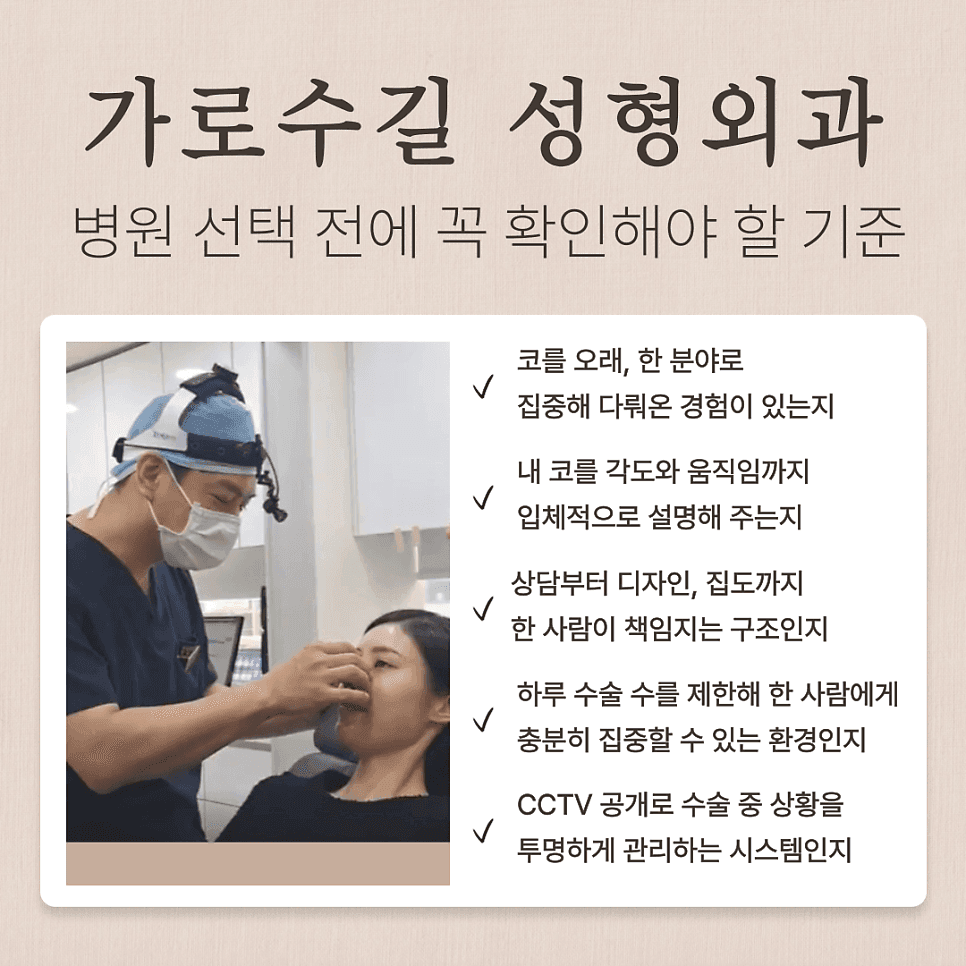
| High-focus environment | Whether daily surgery count is limited to about 2 to concentrate on each patient |
| Transparent operating system | Whether full-process CCTV disclosure and a dedicated single-director responsibility system exist |
| Rib harvest proficiency | Whether they have proficiency performing the difficult rib harvest in about 15 minutes |
Shorter rib harvest time is explained as a factor that lowers the patient's physical burden and aids recovery. What to ask before consultation is in the rhinoplasty consultation prep guide.
05
Summary — set these 4 criteria before consulting
Rhinoplasty isn't simply raising the bridge — it's a process of finding your face's balance and making everyday breathing comfortable. Setting the four criteria — design, material, function, and system — clearly before consultation helps you make a more rational judgment.
If you're curious which design and material fit your face, get checked directly in a 1:1 video consultation.






Frequently asked questions
Answers to common questions patients ask before a consultation.
Since each person's skeleton and nasal structure differ, rather than targeting an identical result, a line fitting your facial proportions gets designed.
If harvest is done in a proficient way, surgery time can shorten. Usually light makeup and daily activity are often possible in about 2 weeks.
Autologous rib cartilage can secure sufficient volume and support — it's a material used even in cases needing reconstruction.
Responses to treatment and recovery progress vary by individual. Outcomes and side effects vary from person to person. Bleeding, infection, swelling and asymmetry may occur. Please consult our medical team before making a decision.
Consultation