
KOWON Blog
Drooping Nasal Tip Surgery: Why the Tip Drops More When You Smile — Support, Muscle and Nasolabial Angle
Three factors to assess before drooping nasal tip surgery: tip support, depressor septi nasi movement and the nasolabial angle. Learn why the tip may droop differently at rest and when smiling.

Key points
- With a drooping nasal tip, the first question is not simply how much to raise the tip, but what is directing it downward.
- If the tip droops even at rest, its supporting structures should be assessed. If it descends further when you smile or speak, the movement of the depressor septi nasi muscle should also be checked.
- The scope of surgery is determined for each patient after separately assessing tip support, muscle movement and the angle between the tip and upper lip, known as the nasolabial angle.
“My nose already looks rather long at rest, and the tip seems to drop even more when I smile.”
This is a concern we often hear from people considering correction of a drooping nasal tip. For some, the tip points downward even at rest and makes the nose look long. For others, the droop becomes more noticeable only when they smile or speak. These cases may look similar from the outside, but different factors can contribute to the downward movement. That is why the surgical plan cannot be based only on how far the tip should be raised.
This article explains why tip support, muscle movement and the angle of the tip are assessed together when planning drooping nasal tip surgery.
01
Why is raising the nasal tip alone not enough to plan correction?
A drooping nasal tip is not simply a matter of moving a tip that already points downward. The position of the cartilage supporting the tip, the nasal septum and nearby structures can all affect its appearance. The condition of the skin and tissue around the tip also needs to be considered.
In more than 20 years of treating rhinoplasty patients, I have found that noses which appear to have the same type of drooping tip often require different points to be assessed. In some cases, tip support is insufficient. In others, a downward pulling force also acts when the person smiles. We therefore do not choose one method based only on the visible droop.
When a long nose and a drooping tip appear together, we assess more than the frontal view. The position of the tip and the nasolabial angle are also checked from the side. In other words, it is more important to determine what is directing the tip downward than simply to ask how high it should be raised.
02
Why assess the muscle when the tip drops further during a smile?
If the nasal tip descends noticeably more when you smile or speak emphatically than it does at rest, muscle movement should also be assessed.
Beneath the nasal tip is a muscle called the depressor septi nasi. It contributes to downward movement of the tip during facial expression. When that movement is pronounced, the tip may look more noticeably drooped during a smile.
For this reason, a consultation does not assess only a still appearance. We may ask you to smile or speak and compare how much the tip position changes between rest and facial expression.
| What do you notice? | What should be assessed? |
|---|---|
| The tip clearly droops even at rest | The structures supporting the nasal tip |
| The tip descends further when smiling or speaking | The influence of muscle movement |
| The tip droops at rest and descends further when smiling | Both structural support and movement |
Put simply, support concerns how the nasal tip is held up, while muscle movement concerns the force that pulls it downward when you smile or speak.
03
What determines the surgical approach for a drooping nasal tip?
The factors identified during assessment help determine which areas may need correction.
- 01Nasal tip support — If substantial support is needed, the supporting method and cartilage material are considered together.
- 02Movement during facial expression — If the tip descends markedly during a smile, we assess whether muscle correction needs to be considered.
- 03The angle between the tip and upper lip — When the tip needs to be raised, we also assess the nasolabial angle and how much of the nostrils is visible.
The amount of tip elevation is not decided by height alone. Rotating the tip can change both nostril visibility and the overall impression of the nose, so the relationship between the tip and upper lip is considered as well. You can read more about the factors assessed in tip correction on our nasal tip surgery page.
Ultimately, the scope of correction should be determined for the individual after assessing support, muscle movement and tip angle separately.
04
In summary — identify the contributing factors first
When a drooping nasal tip is a concern, it is natural to begin by asking how much it should be raised. However, if its appearance differs at rest and during a smile, a photograph alone may not distinguish the cause. Assessing both tip support and movement during facial expression helps determine which areas, including the muscle, may need attention. The surgical method should be chosen after considering the current condition of the nose as a whole, rather than from a single criterion.
If you would like to understand how your nasal tip changes between rest and smiling, you can have it assessed during a one-to-one video consultation. You can also view actual correction examples in our before-and-after gallery.
Frequently asked questions
Answers to common questions patients ask before a consultation.
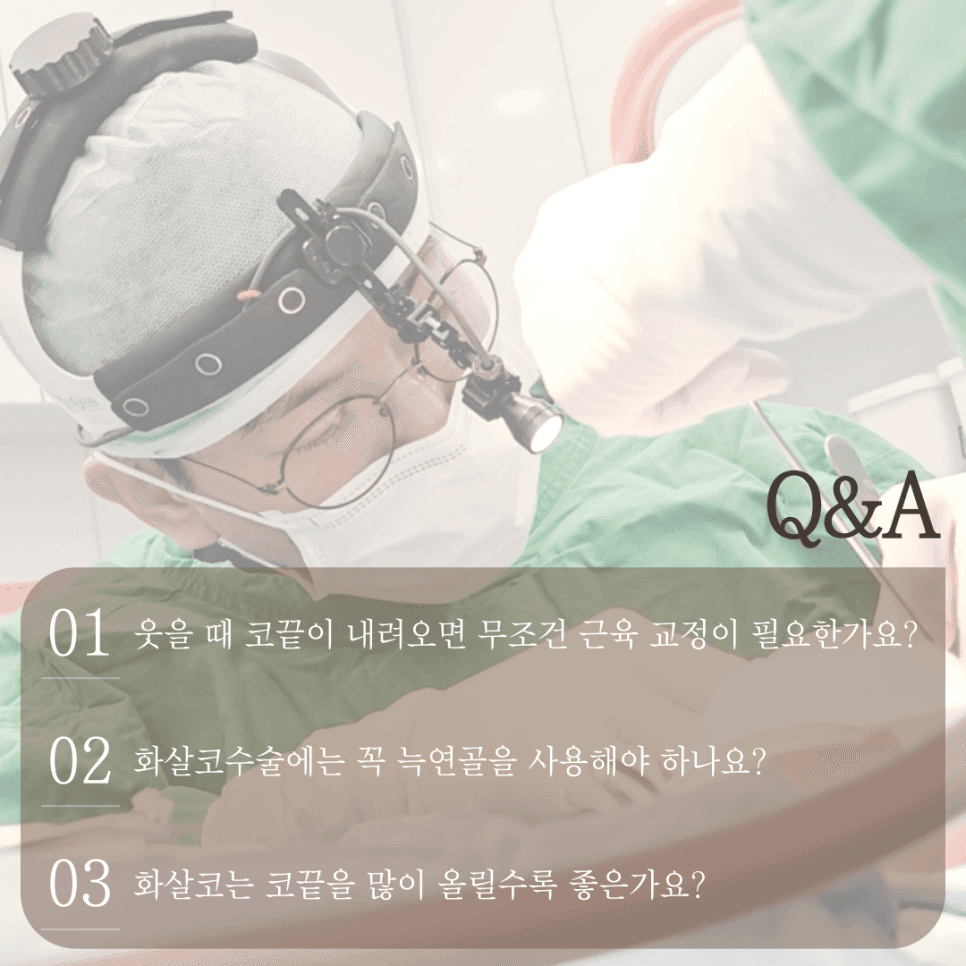
No. When the tip looks acceptable at rest but droops noticeably during a smile, the influence of muscle movement can be assessed. If it is already drooped at rest, the supporting structures should also be examined before deciding whether muscle correction is appropriate.
The same material is not required in every case. As with the first decision factor above, the amount of support needed and the condition of the existing cartilage are assessed before choosing a material. Autologous or donated rib cartilage may be considered when necessary.
The amount of elevation is not the goal by itself. The nasolabial angle and the degree of nostril visibility should be considered together. Even with a similar drooping-tip appearance, an appropriate range can vary with the existing nose and facial structure.
Responses to treatment and recovery progress vary by individual. Outcomes and side effects vary from person to person. Bleeding, infection, swelling and asymmetry may occur. Please consult our medical team before making a decision.
Consultation