

Hello, this is Hyung-taek Kim, director of KOWON Plastic Surgery.
During the consultation, I observed that the line from the nasal bridge to the nasal tip was generally low, and the nose itself was rather small, so the central facial area lacked some three-dimensionality.
Additionally, because the angle between the nasal tip and the lips was narrow, it gave the impression that the mouth area was slightly protruding forward.
When operating on this type, rather than simply increasing the height, the key is to delicately perform nasolabial angle correction along with adjusting the angle of the nasal tip, to smoothly refine the contour leading to the lips.
Considering the overall facial balance, I appropriately augmented the lacking nasal bridge height and built a strong support at the nasal tip to maintain a stable angle and height for a long time.
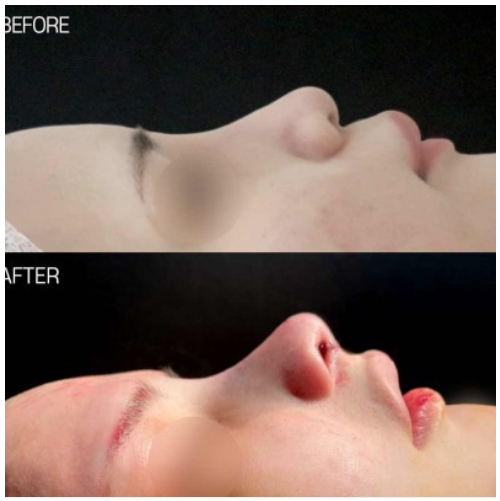
In particular, by simultaneously performing nasolabial angle correction connected to the philtrum line, the previously protruding mouth area was naturally subdued, and the line descending from the nasal tip to the lips was smoothly refined.
When operating on a small and low nose, rather than blindly increasing the height, you must also adjust the angle between the philtrum and the nasal tip so that the mouth area is refined and the overall facial three-dimensionality is naturally enhanced.
In fact, many people with small and low noses who want a natural style show me photos of certain celebrities.
However, when you closely analyze those photos, although they appear natural, most of them actually have a distinct nasal bridge starting point or a well-defined nasal tip contour, and the height is quite prominent and glamorous.
The reason such designs do not look overwhelming and suit those individuals well is because the curve descending from the forehead and the nasolabial angle are stably secured, and there is sufficient three-dimensionality in the midface.
"In many cases, even celebrity noses that appear natural are based on a stable angle and midfacial volume, so it is most important to delicately refine the line to match your own skeletal flow."
Therefore, rather than blindly copying visible height or shape, considering overall harmony and simultaneously adjusting the flow of the nasolabial angle and philtrum leads to more satisfying results.
By refining the line so precisely, not only did the previously flat midface gain three-dimensional vibrancy, but the small-looking nose also regained its presence, resulting in a much clearer and more balanced overall impression.
[Related cases worth viewing]
[What was the case?]
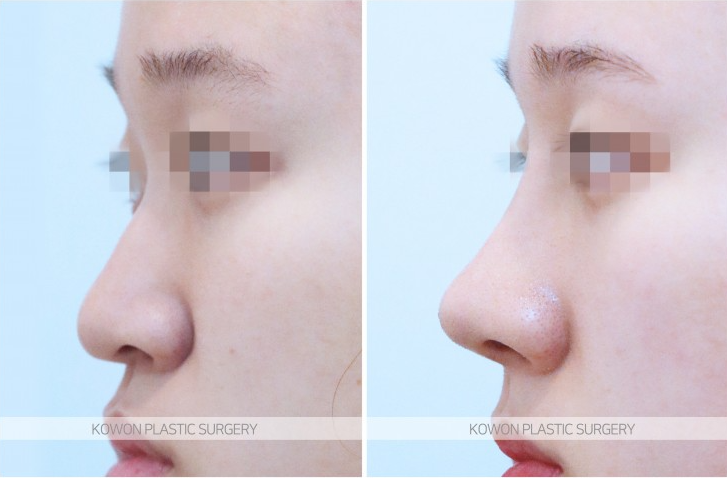
The nasal bridge was generally low and long, and the nasal tip drooped downward in an arrow nose (droopy tip) shape. Especially when smiling or making facial expressions, the depressor septi nasi muscle acted strongly, pulling the nasal tip further downward and even affecting the mouth area.
[What procedures were performed?]
To correct the arrow nose (droopy tip) shape, the muscle responsible for pulling the nasal tip downward, the depressor septi nasi muscle was excised in the surgery. At the same time, a solid support was built using autologous cartilage and the nasal bridge height was increased while refining the angle through nasolabial angle correction to stably elevate the nasal tip and create a smooth contour.
[How did it change?]
The previously drooping and downward nasal tip was lifted more lightly and neatly, improving the proportion of the previously long-looking nose and making the overall line much more refined. Through such precise angle adjustment as proposed by KOWON Plastic Surgery, the nasal tip no longer drooped when smiling, resulting in a stable and smooth impression.
[Key points in this case]

The core of this surgical case is that, rather than simply increasing the height, nasolabial angle correction was delicately performed to adjust the contour connecting the philtrum and mouth area. To achieve satisfactory results in rhinoplasty, the specifications of the nose itself are important, but a design that considers the three-dimensionality and flow of the entire midface must come first.
"Rhinoplasty should go beyond simply increasing the visible height of the nose, and only through delicate angle redesign tailored to the proportions of the mouth area and entire midface can the most suitable, unique line be achieved."
At KOWON Plastic Surgery, we thoroughly analyze each patient's skeletal characteristics and proportions to find a natural yet sophisticated line, so we encourage you to find a customized improvement plan that suits you best.
KOWON Plastic Surgery Clinic
2nd Floor, KBL Center, 110 Dosan-daero, Gangnam-gu, Seoul
View original post on Naver Blog
This procedure/surgery may cause side effects such as bleeding, infection, swelling, or asymmetry depending on the individual. For accurate information, please consult with medical staff before making a decision.
— Dr. Hyung-taek Kim, KOWON Plastic Surgery