

Hello, this is Hyung-taek Kim, director of KOWON Plastic Surgery.
The case I encountered this time involved a nose with a slightly raised area in the middle of the nasal bridge, with a low dorsal hump, and the outer alar base was lifted, causing excessive nostril exposure from the front—a yongko (nostril exposure) condition.
This type is different from a typical upturned nose, as the curling of the alar base itself and the pronounced outer nostril exposure make the nasal tip appear short and awkward when viewed from the front.
Moreover, the overall nasal bridge height was rather insufficient, which made the dorsal hump area stand out even more, resulting in an uneven line and a lack of three-dimensionality.
For cases with these characteristics, simply shaving down the dorsal hump, raising the nasal tip, or narrowing the nostril width alone has clear limitations, so it is essential to closely examine the interrelationship between the nasal bridge, tip, alar base, and nostrils to refine the entire structure.
At KOWON Plastic Surgery, we designed the dorsal hump area to be smoothly contoured in harmony with the overall facial proportions, ensuring the nasal bridge line flows seamlessly, and rather than forcibly increasing the height, we adjusted it to intersect naturally with the nasal tip.
For the nasal tip surgery, we gathered the cartilage through repositioning and suturing, then added autologous cartilage to achieve the ideal height, and built a solid support structure in between to ensure the nasal tip remains stable over time.
Especially in cases like this, where the outer alar base is lifted and the nostrils are exposed, simply pulling down the nasal tip may not be enough, so we performed alar rim lowering in parallel to ensure the lower alar line settles naturally downward.

These before-and-after photos are used with the patient's consent.
Here, alar rim lowering is not just a procedure to cover the nostrils, but a key step to find the golden ratio between the columella and nasal tip, reduce the frequency of frontal nostril exposure, and create a more stable and sophisticated appearance.
It is not enough to simply pull the alar base downward; only by grafting additional cartilage tissue and firmly fixing it to prevent the alar base from contracting and rising again can a highly complete result be achieved.
Furthermore, we meticulously refined the columella angle, nasolabial angle, and the curve leading to the philtrum, guiding the flow from the nasal tip to the mouth for a smooth transition, which helped the previously protruding mouth area settle and improved the side profile to appear much more natural and refined.
The recent trend focuses not on simply increasing height, but on creating lines that blend with the overall facial harmony while highlighting detailed aesthetics, and especially in yongko or nostril exposure cases, it is even more important to thoroughly consider alar base balance.
In this case as well, we set aside excessive ambition and prioritized individual character and harmony, applying KOWON Plastic Surgery's precise alar rim lowering expertise to achieve the most natural and sophisticated form.
[Related Reference Case]
Let me introduce a real improvement case related to nasal bridge augmentation. The patient in this case chose yongko surgery to refine the nasal bridge line more clearly and visited KOWON Plastic Surgery.
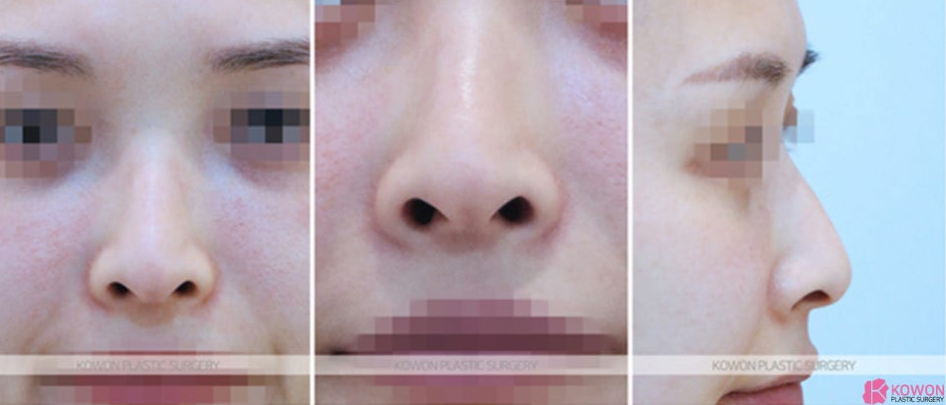
These preoperative photos are used with the patient's consent.
A close examination of the preoperative appearance from the front, below, and side angles revealed a dorsal hump in the middle of the nasal dorsum. The overall nose height was relatively sufficient, but the nasal dorsum had a narrow structure.
Especially when viewed from the front, the nasal tip was slightly upturned, making the nostrils appear somewhat prominent.
A slight asymmetry was also observed, with the centerline of the nasal bridge deviating to one side. Some degree of asymmetry is common in the nasal bridge, but in this case, the dorsal hump made it even more noticeable. Although the nasal bridge was not very low preoperatively, the dorsum was narrow and the glabella area appeared somewhat sunken, which was a drawback.
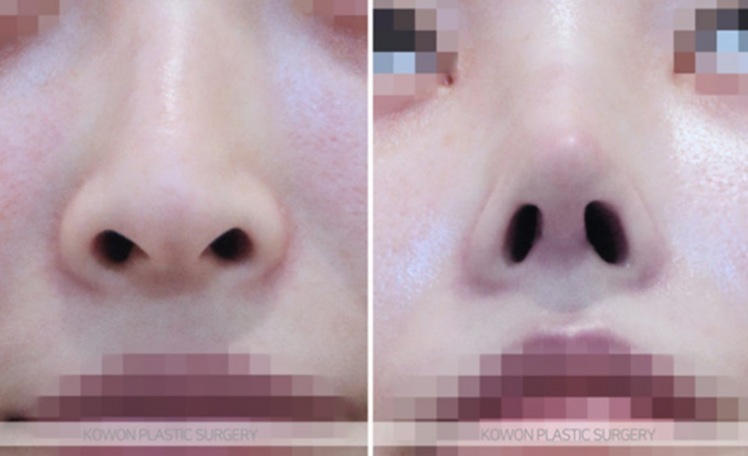
These before-and-after photos are used with the patient's consent.
In particular, this patient had previously undergone procedures using filler and dissolvable threads, so, to achieve a more stable and complete nasal bridge augmentation, we decided to thoroughly remove the existing filler and threads before proceeding with the main yongko surgery.
Accordingly, when performing the nasal bridge augmentation, we avoided excessive changes and focused on balancing the overall structure by using only a small amount of thin silicone. By reducing the risk of side effects and increasing stability in this way, the previously wide nostril exposure decreased over time, and the twisted appearance from the front was refined, resulting in a much more natural and satisfying outcome.
[A Word from the Director]
For noses with dorsal hump, yongko, and nostril exposure combined, as in this case, simply raising the height or applying a uniform method will never yield satisfactory results. At KOWON Plastic Surgery, rather than pursuing excessive ambition, we thoroughly analyze each individual's anatomical structure and alar base balance, and with delicate alar rim lowering and customized design, we achieve the most harmonious and natural refined lines.

By focusing solely on each individual's anatomical structure and balance,
we promise unchanging naturalness over time.
We always devote ourselves to meticulously correcting even past procedure history and subtle asymmetries, so that more stable and sophisticated beauty can be maintained as time passes. If you are curious about the ideal harmony of a nose that best suits your face, please feel free to reach out anytime.
KOWON Plastic Surgery Clinic
2nd Floor, KBL Center, 110 Dosan-daero, Gangnam-gu, Seoul

This procedure/surgery may cause side effects such as bleeding, infection, swelling, or asymmetry depending on the individual. Please consult with medical staff for accurate information before making a decision.
— Dr. Hyung-taek Kim, KOWON Plastic Surgery