
KOWON Blog
Making a straight nose with revision rhinoplasty — can filler be combined too? Answering 5 Naver Knowledge iN questions
Five questions from someone considering straight-nose revision after silicone + ear cartilage rhinoplasty — answers on reusing the previous ear cartilage, lowering the tip further, whether adding silicone alone works, and cautions for combining lipolysis injections and nose filler.

Key points
- Ear cartilage used in the previous surgery can generally be reused in revision — but whether it can be used depends on cartilage condition and absorption, judged after examination.
- A straight-nose line isn't completed just by adding more silicone — tip support, cartilage arrangement, and skin condition must be viewed together.
- Adding filler to a nose that already contains an implant and cartilage can rarely cause complications like skin necrosis or blocked blood flow — it must be decided very cautiously.
"Last year I had rhinoplasty with 3mm silicone and ear cartilage — looking back now, what I wanted from the start was a straight nose. If I have revision, can the old ear cartilage be reused? Could I try nose filler first to improve it?"
This is a question received while working as a HiDoc-Naver Knowledge iN plastic surgery consultant. The first surgery wasn't a failure — the result didn't look operated and suited the face, reasonably satisfactory — but over time the tip upturned and the nose looked short, prompting thoughts of revision. Questions in this situation are mostly similar, so organizing the answers should help others with the same concern.
01
Can ear cartilage used before be reused in revision?
Generally, reusing ear cartilage used in the previous surgery during revision rhinoplasty is possible. However, whether it can be used changes depending on the cartilage's condition and whether it has been absorbed — so in practice it's judged after examination.
You also asked whether the tip can be lowered further, having heard it was lowered as much as possible at the time of surgery. This part can only be judged accurately by seeing and touching the nose directly — the flexibility of tip soft tissue, skin thickness, and support structure must be considered to evaluate whether straight-nose surgery is feasible.
02
A straight-nose line — isn't it enough to just add a little more silicone?
You may think "wouldn't simply adding a bit more silicone do it" — but adding silicone alone doesn't complete the straight nose you want. Stable results can be expected only when tip support, cartilage arrangement, skin condition, and other factors are considered together.
Especially in revision, there is more to check than in a first surgery. If you want to know these judgment criteria in advance, you can refer to the revision guide.
03
Can lipolysis injections or nose filler be done on an operated nose?
This question can only be answered cautiously. Organized by question:
| Question | Answer in brief |
|---|---|
| The tip is fleshy so a straight line doesn't show — can lipolysis injections slim it? | Theoretically possible to try, but an already-operated nose has sensitive tip tissue so it must be approached very carefully. Injecting aggressively can distort the shape or cause tissue damage. |
| Can I get nose filler after rhinoplasty? | Possible, but it must be decided very cautiously. Adding filler when an implant or cartilage is already in place can rarely cause complications like skin necrosis or blocked blood flow — it must be discussed with experienced medical staff. |
| Should I try filler first before revision? | Revision rhinoplasty, straight-nose surgery, and combining nose filler are all possible options — but order and method should be set after accurate diagnosis. |
To summarize — combining nose filler for fine balance adjustment or volume supplementation after surgery is possible in itself, but the timing of filler, the right site, and material choice are very important.
04
How did similar revision cases go?
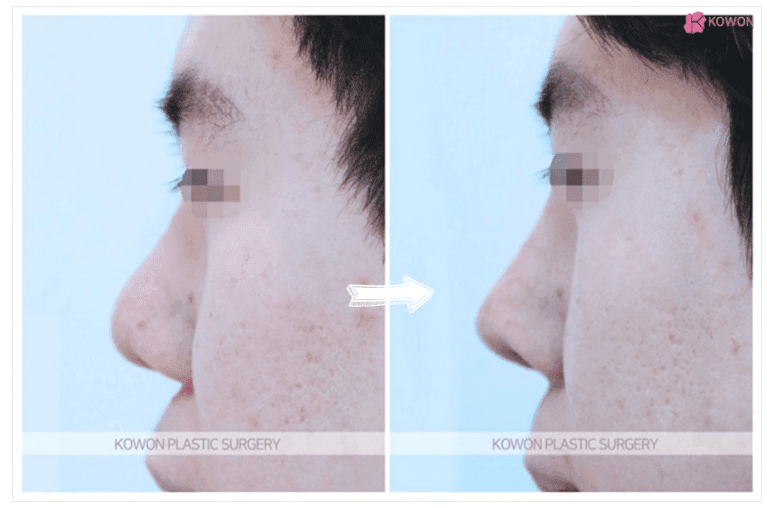
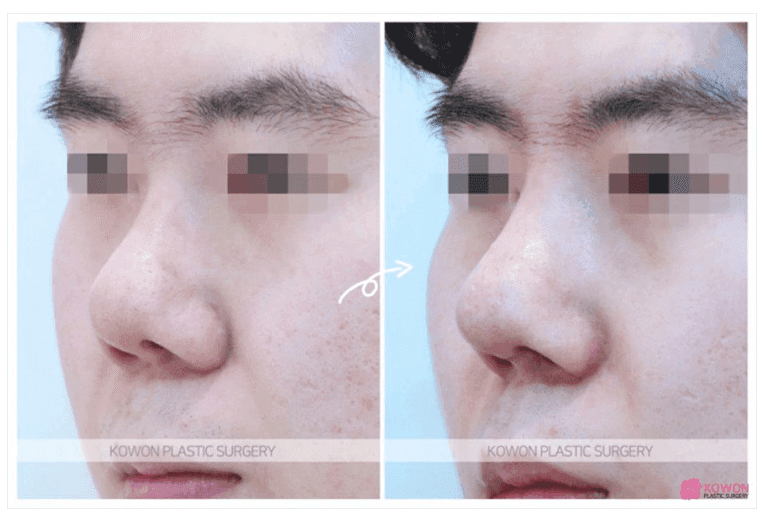
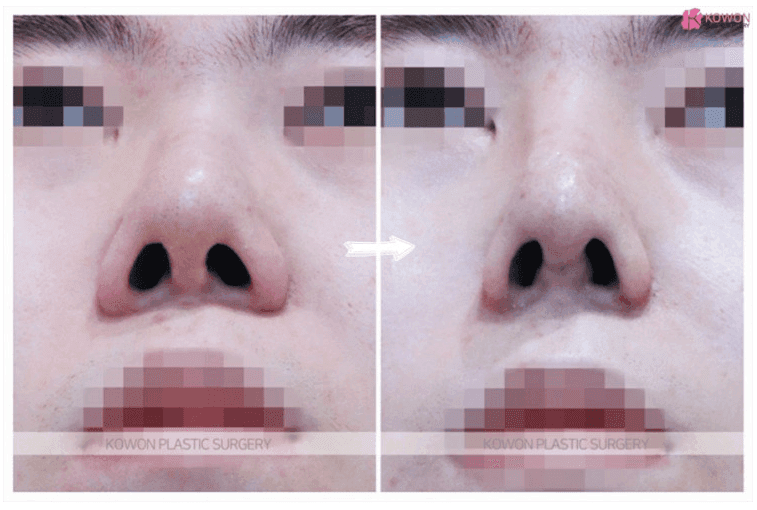
Introducing one revision case that included alar reduction — since it was a revision, sensitivity to post-op pain was high, so per the patient's request it was performed under IV sedation; because the amount of cartilage needed might be insufficient, the possibility of harvesting additional ear cartilage was explained and consent obtained before surgery. About 3~4mm of silicone was used to create the line, and the saddle-nose problem worried about before surgery did not occur. The impression of a protruding mouth caused by a narrow nasolabial angle also improved as the angle was adjusted. Cases like these can be seen in before-and-after photos.
05
Summary — diagnosis comes before sequencing
Lingering attachment to a straight nose, filler as an option, whether ear cartilage can be reused — the questions branch many ways but the answer converges to one place. Adding silicone alone doesn't make a straight nose, and filler isn't always a safe shortcut — only after directly checking the nose's current support structure and tissue condition can the right method be decided. If visiting is difficult, it's recommended to first get a judgment on your current state through a 1:1 video consultation.

Frequently asked questions
Answers to common questions patients ask before a consultation.
Many people consider revision not only when the result is unsatisfying but also when the shape has changed over time or attachment remains to a line not chosen initially (e.g., a straight nose instead of a natural nose). What matters is accurate diagnosis and finding the surgical direction that fits you.
Adding filler to an operated nose is possible but must be cautious. If an implant and cartilage are already in place there's a rare risk of complications like skin necrosis or blocked blood flow — so it's safer to decide through examination whether to even attempt filler or go to revision.
First check whether the previously used ear cartilage can be recycled; if the amount may be insufficient, the possibility of additional ear cartilage harvest is explained before surgery and the procedure proceeds after consent.
Responses to treatment and recovery progress vary by individual. Outcomes and side effects vary from person to person. Bleeding, infection, swelling and asymmetry may occur. Please consult our medical team before making a decision.
Consultation