
KOWON Blog
My nose tip drops when I smile. Is lifting the tip enough?
Learn why the nasal tip can look lower when smiling, how structural tip surgery differs from muscle correction, and what to ask about changes in movement, sensation and surgical risks.
Key points
- A drooping appearance when smiling may involve movement of the upper lip and nasal wings as well as the tip itself.
- Structural tip surgery addresses cartilage shape, direction and support; muscle correction addresses expression-related pulling forces. The appropriate approach depends on the cause.
- Consider possible changes in how smiling feels and in sensation alongside the desired appearance. Movement alone does not mean surgery is necessary.
If cartilage shape and support are the main issue, structural tip surgery may be central to the plan. If a downward pull during smiling contributes to the droop, the need for muscle correction should also be assessed. Whether lifting the tip is enough depends on evaluating its structure at rest separately from its movement with facial expression.
Your nose may look fine at rest, yet the tip appears longer in smiling photographs. It helps to distinguish “I would like it to drop less when I smile” from “I also want a higher tip at rest.” Even when both concerns involve the nasal tip, the features that need assessment depend on what you want to change.
01
Why does the tip look lower when I smile?
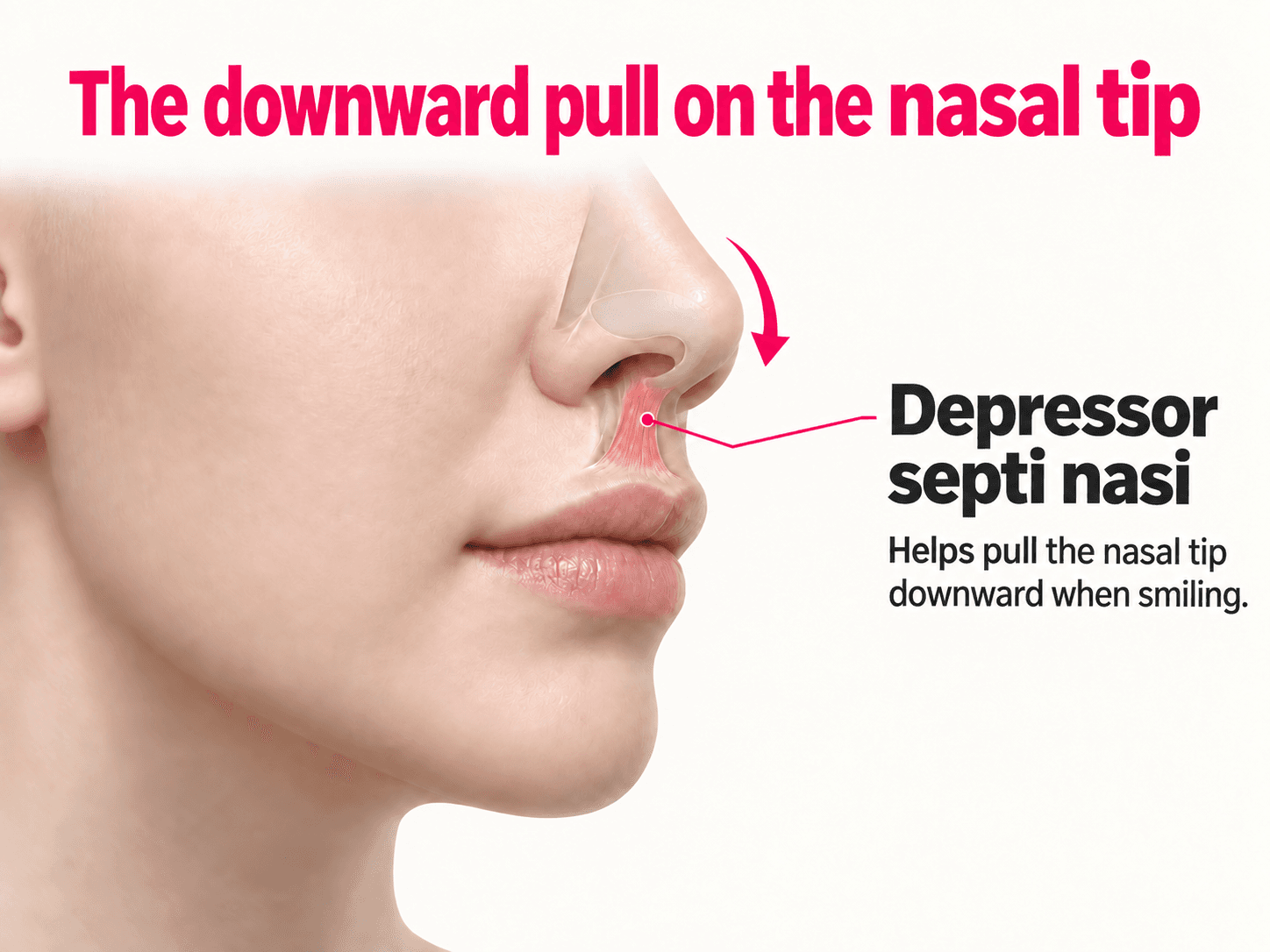
A downward pull on the tip and upward movement around the upper lip and nasal wings can both contribute. A muscle beneath the nose called the depressor septi nasi helps pull the tip downward when smiling. If this action is pronounced, the droop may be more noticeable. Literature on structural and dynamic causes of a drooping nasal tip
The illustration below simplifies the approximate location of the muscle beneath the tip and the direction of its pull. It cannot establish an individual's muscle condition or the extent of surgery needed.
02
Is the nasal tip the only part that moves?
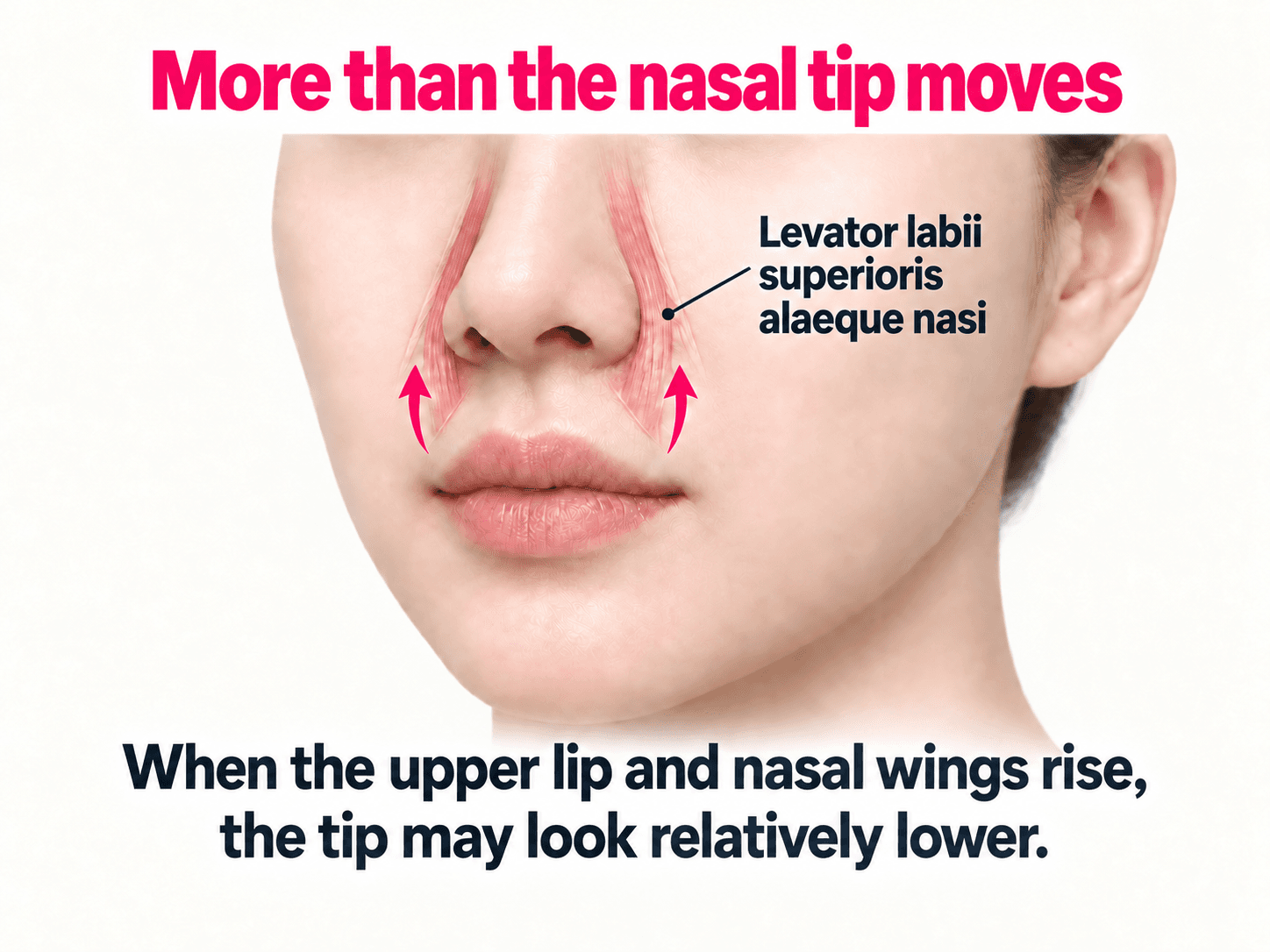
No. Upward movement of the upper lip and nasal wings can also make the tip look relatively lower. A low-looking tip in a smiling photograph does not necessarily mean the tip itself has moved downward by that amount. Comparing the face at rest and while smiling therefore involves looking at the tip and the surrounding structures separately. Explanation of relative tip drooping during facial expression
The illustration below shows the approximate location and action of the levator labii superioris alaeque nasi, a muscle involved in lifting the upper lip and nasal wings. The highlighted areas and arrows indicate approximate locations and directions of movement, not surgical boundaries or changes in a particular patient. They help distinguish a downward pull beneath the tip from upward movement around it. Literature describing the actions of both muscles
03
How does structural tip surgery differ from muscle correction?
Structural tip surgery changes cartilage shape, direction and support, while muscle correction changes the pulling forces acting on the tip during facial expression. Even if both are described as “lifting the tip,” ask which feature the proposed procedure is intended to change.
In practical terms, the assessment considers both how the tip is supported and what forces act on it when you smile. Plans to adjust cartilage position or shape, or to reinforce support, depend on the existing structure. Clinical paper on tip position, support and correction
If you want to preserve the height at rest and are concerned only about smiling, first ask whether adding height fits that goal. If the tip also droops at rest, a discussion limited to muscles may not fully explain the issue. Clarifying what you want to preserve and what you want to change comes first.
| Approach | Main target | Intended change and points to assess |
|---|---|---|
| Structural tip correction | Cartilage shape, direction and support | Adjusts the baseline position and shape. Expression-related pulling forces also need assessment. |
| Nasal tip muscle correction | Muscular pull on the tip during smiling | Aims to reduce expression-related drooping. It does not address every aspect of cartilage shape or support. |
| An approach considering both structure and muscles | Baseline support and movement with expression | Takes each factor into account when both contribute. Not everyone needs both procedures. |
Reinforcing support does not mean raising the tip substantially. It means considering the direction and degree of support needed within the existing structure, together with the relationship to the face and lips.
04
Does drooping when smiling always require muscle correction?
Drooping during a smile alone is not a reason to decide on muscle correction. The assessment should consider movement of the tip itself, the impression created by surrounding structures moving upward, and the support provided by the cartilage. Identifying a muscular contribution and deciding on muscle surgery are separate steps.
There is also more than one way to address the muscles. A 2015 systematic review of depressor septi nasi surgery described varied techniques and a lack of objective evidence establishing the superiority of a particular method. The term “muscle correction” does not mean that the extent of surgery or its results will be the same in every case.
During consultation, ask which structures contribute to the droop and how the proposed correction would change them. Even when muscular pull needs to be addressed, the expected change should be weighed against the burden of surgery.
05
Could muscle correction change how my smile feels?
Yes. Reduced upper-lip sensation or a feeling of restricted movement can occur after surgery. Research on depressor septi nasi correction describes local swelling and these sensory and movement changes. They may be temporary, but recovery cannot be promised to follow the same course for everyone. The cited study was a small retrospective study, which limits its ability to predict an individual's degree of change or likelihood of symptoms. Risks of muscle correction and study limitations
Rhinoplasty also carries risks such as infection, breathing difficulties, scarring, an appearance different from what was expected, and the possibility of revision surgery. It is important to consider whether the change you want is worth accepting those risks. American Society of Plastic Surgeons: rhinoplasty safety
If your smile is the reason you are considering surgery, how smiling may feel afterward is an important part of the decision. Alongside changes in tip shape, ask about movement that may remain and symptoms to watch for during recovery.
06
What should I discuss during consultation?
Show your face both at rest and while smiling, and explain exactly when and what bothers you. Describing the desired change clearly helps guide the discussion. You can prepare questions such as these.
- Separate what you want to keep from what you want to change: “I am happy with the height at rest, but would like the tip to drop less when I smile.”
- Ask: “How do cartilage shape, support and muscle movement each contribute in my case?”
- Clarify: “What would the proposed procedure change, and what might remain? Could it change how smiling feels or the sensation in my upper lip?”
You can read about the procedures described by KOWON in the nasal tip drooping and muscle correction guide. To prepare, refer to the consultation guide and note the appearance that concerns you. Discussing both the desired shape and facial expression is a starting point for understanding a surgical plan.
The first three questions below can also help you understand the plan discussed during consultation.
Frequently asked questions
Answers to common questions patients ask before a consultation.
No. The need is assessed after considering movement of the tip itself, the impression created by surrounding structures moving upward, and baseline cartilage support. Movement during smiling alone does not determine whether muscle surgery is appropriate.
Not every case requires rib cartilage. The choice depends on the amount of support needed and the condition of the existing cartilage. The literature also describes reinforcing support with septal or ear cartilage. Neither the label “drooping tip” nor the inclusion of muscle correction determines the material by itself. Literature on tip support and cartilage selection
Greater height is not the goal in itself. The existing tip position, its relationship to the upper lip and face, and the change you want all matter. First explain whether you want to preserve the resting appearance and change only the impression when smiling.
A downward-looking tip during smiling is sometimes described as an “arrow nose” in Korean. That shape label does not establish the cause. The assessment should consider whether the tip also points downward at rest and how much its appearance changes with expression.
A photograph alone cannot establish the need. It can help communicate what concerns you, but movement of the tip, relative changes around it and the state of its support need to be assessed together. Another person's static before-and-after photographs likewise cannot show how your nose moves when smiling or which correction you need. It is better to distinguish these factors during an examination than to conclude from a photograph that the problem is muscular.
Movement alone does not require surgery. Consider whether you want a change, what can realistically be corrected, and whether you are willing to accept surgical risks. If your current appearance does not significantly bother you, choosing not to have surgery is also an option.
Responses to treatment and recovery progress vary by individual. Outcomes and side effects vary from person to person. Bleeding, infection, swelling and asymmetry may occur. Please consult our medical team before making a decision.
Consultation