
KOWON Blog
How long should you wait for lower eyelid fat repositioning after rhinoplasty? — judging by swelling and surgical order
If you're getting rhinoplasty and lower eyelid fat repositioning at different clinics — why a one-week rule or same-day surgery shouldn't be generalized, and why both teams plus anesthesia staff must coordinate the anesthesia plan.

Key points
- If rhinoplasty is done first, swelling can rise up around the eyes and interfere with lower eyelid fat repositioning surgery.
- "One week" isn't a standard that applies to every surgical range and recovery — the interval is set by directly checking peri-eye swelling, bruising, wounds, and anesthesia recovery.
- Don't arbitrarily book consecutive same-day surgeries at different clinics — both surgical teams and anesthesia staff must coordinate order, fasting, medication, and emergency response in advance.
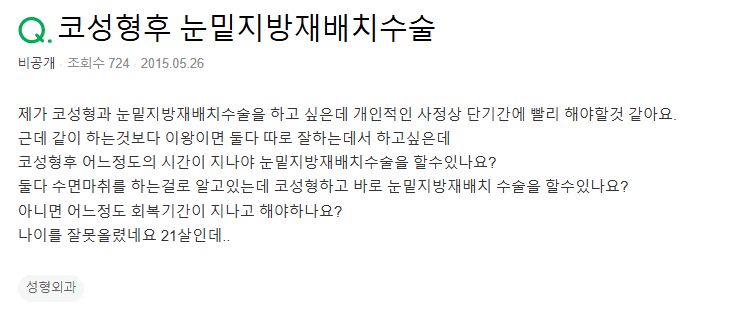
"I want rhinoplasty and lower eyelid fat repositioning at different clinics — how long after rhinoplasty can I get the eyelid surgery?"
This is a question covered in an actual consultation answer. The questioner was a 21-year-old adult in a situation where both surgeries had to happen within a short window. Rather than doing both at once in one place, they wanted surgery separately — at a clinic good at rhinoplasty and one good at lower eyelid fat repositioning — and asked whether, understanding both proceed under sedation anesthesia, they could get the eyelid surgery right after rhinoplasty or whether a recovery period was needed.
This article organizes the answer to that question.
01
Why can't you get lower eyelid fat repositioning right after rhinoplasty?
If rhinoplasty is done first, swelling doesn't stay only in the nose — it rises around the eyes. Since lower eyelid fat repositioning operates on the under-eye area, this swelling can interfere with surgery.
Not just swelling but bruising, wounds, infection signs, medication taken, and anesthesia recovery must be checked together. Don't judge that the next surgery is possible just because the outside looks less swollen.
02
How long should you wait for rhinoplasty swelling?
There's no fixed one-week rule. The interval is set by both surgical teams checking the rhinoplasty's range, peri-eye swelling·bruising·wounds, and anesthesia recovery state.
| Situation | Judgment |
|---|---|
| Right after rhinoplasty | Swelling can rise around the eyes and interfere with lower eyelid fat repositioning |
| If swelling isn't severe | Don't decide on appearance alone — assess wounds, medication, anesthesia recovery |
| Next surgery schedule | Decided individually by both surgical teams·anesthesia staff |
The pace of swelling resolution and overall recovery is covered in more detail in the rhinoplasty recovery guide.
03
If you want both surgeries within a short period, what order is good?
If both surgeries must happen within a short period, rather than the patient arbitrarily swapping the order, inform both clinics of the full other surgical plan. Consecutive same-day surgery involves fasting, cumulative sedation or general anesthesia, prescription overlap, and transfer·emergency-response issues — so it's considered only when both surgical teams and anesthesia staff have verified safety and coordinated it into one plan.
04
Summary — changing the order shortens the wait
The interval between rhinoplasty and lower eyelid fat repositioning isn't generalized as a week or a fixed order. The more they're done at different clinics, the more both surgical teams and anesthesia staff must coordinate swelling, wounds, medication, anesthesia recovery, and emergency response into one plan.
If you're curious which order and interval fit your situation, verify directly in a 1:1 video consultation.
Frequently asked questions
Answers to common questions patients ask before a consultation.
It isn't set as a fixed number of days. The interval is set by both surgical teams checking peri-eye swelling·bruising·wounds, medication taken, and anesthesia recovery.
The patient shouldn't arbitrarily move between two clinics for consecutive surgeries on the same day. It's considered only when both surgical teams and anesthesia staff have agreed in advance on fasting, anesthesia, prescriptions, transfer, and emergency response.
Possible — but you must disclose the full other surgical plan and prescriptions to each clinic, and the responsible teams must coordinate order, interval, anesthesia, and emergency contact structure among themselves.
Responses to treatment and recovery progress vary by individual. Outcomes and side effects vary from person to person. Bleeding, infection, swelling and asymmetry may occur. Please consult our medical team before making a decision.
Consultation