
KOWON Blog
Nasal muscle correction — when the nose looks spread when smiling: why alar reduction alone falls short
When the alae look spread when smiling: why the levator labii superioris alaeque nasi's action gets checked, how nasal muscle correction proceeds, and why support structure and autologous rib cartilage get considered together for durability — organized.
Key points
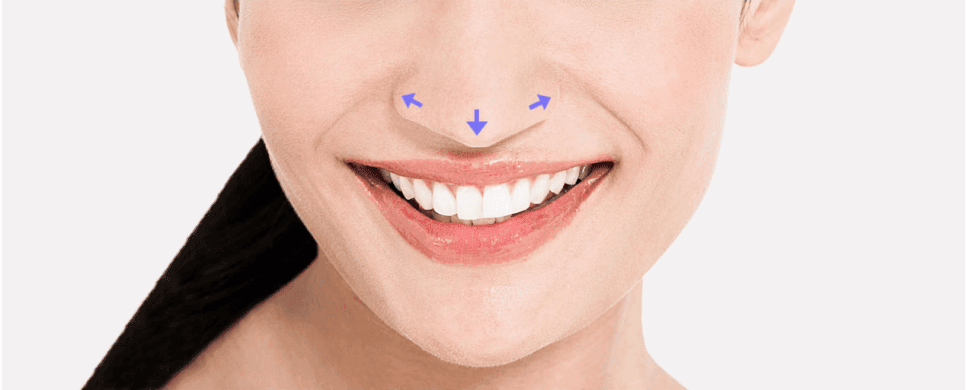
- If the nose looks spread when smiling, check not only alar size but the action of the muscle that flares the alae sideways (levator labii superioris alaeque nasi).
- When muscle movement is strong, alar reduction alone is insufficient — repeated muscle use over time can re-spread the nose.
- For results to last, look beyond muscle correction to a design that builds internal support structure — where autologous rib cartilage is often used.
"To correct a spread nose, must nasal muscle correction come first?"
One of the questions frequently received in the clinic. When the alae look wide and spread, it's easy to think 'wouldn't just making the nostril sill smaller work?' In reality, cartilage shape, inner-nose structure, skin thickness, and nasal muscle movement must all be analyzed together to reach a natural, highly satisfying result. This article organizes why muscles get checked too when the nose looks spread when smiling.
01
Why can a spread nose fall short with alar reduction alone?
If the cause is the action of the muscle pulling the alae sideways when smiling, reducing alar width alone can leave the recurring flaring force behind. Even when outward appearance looks similar, the cause differs per person — so alar size and muscle movement must be distinguished together.
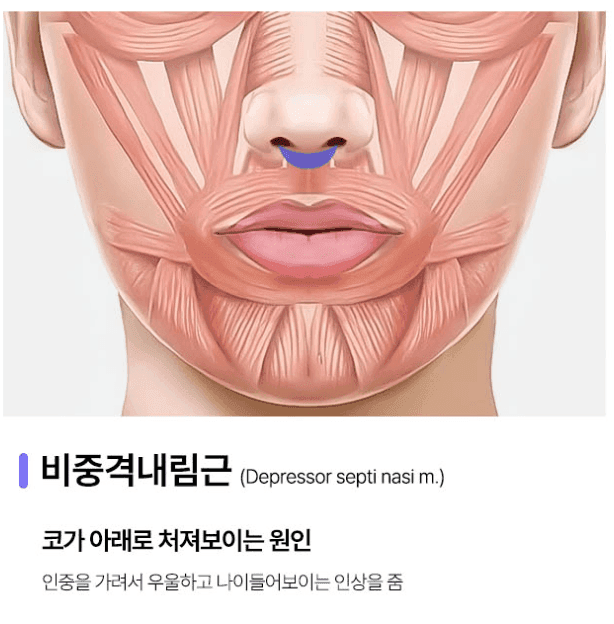
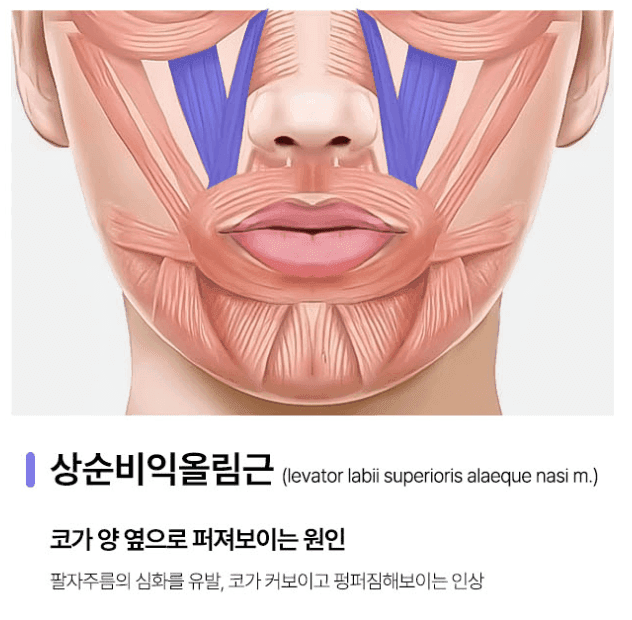
One common case is excessive nasal muscle movement. The levator labii superioris alaeque nasi around the tip acts to flare the alae sideways when speaking or smiling. Especially for those with a wide mouth or who've heard 'your nose spreads when you smile,' this muscle's action is often strong.
Then what happens with alar reduction alone? Repeated muscle use over time can create the problem of the nose spreading again. So in such cases, a process reducing the nasal muscle itself must proceed together.
02
How does nasal muscle correction proceed?
Many ask back 'can muscles be corrected too?' — and yes, adjustment is possible. If the following applies, reducing only the alae falls short; the force flaring them from both sides must itself be reduced.
- The nose looks too spread when smiling
- A feeling of re-spreading despite correction
- The alae look wide in photos
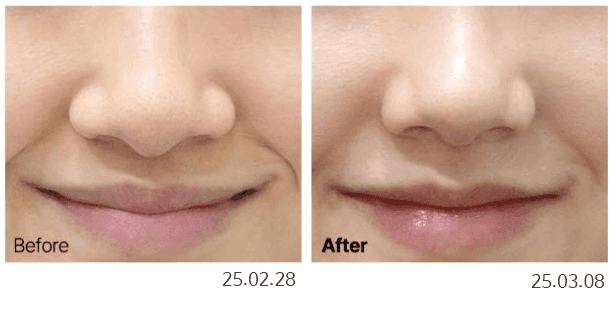
Nasal muscle correction proceeds through the inside of the nose, so it leaves no visible scar and doesn't significantly disrupt daily life. Inside the nose, the levator labii superioris alaeque nasi is carefully identified and the excessively acting portion is partially cut. It's a relatively simple process finishing in a shorter time than other methods. After correction, the nose doesn't spread further even when smiling, and the tip and alae connect smoothly with a tidier line.
03
What else must be checked for results to last?
Spread-nose surgery can look well-set at first, then re-flare or loosen over time more often than expected — often because cartilage wasn't properly organized or only the surface was slightly reduced without touching the muscle. So look beyond immediate results to how long-lasting the result was designed to be.
| What to check | Why it matters |
|---|---|
| Muscle movement | Without reducing the flaring force, the nose can re-spread |
| Internal support structure | Without firm support, the shape can loosen over time |
| Material choice | If cartilage is thin and weak, tying alone is insufficient |
One material often used when building internal support structure is autologous rib cartilage. It has strong support, doesn't lose shape over time, and — being tissue from one's own body — carries almost no foreign-body reaction. Especially for those whose cartilage is thin and weak, simply tying is insufficient; erecting a pillar firmly supporting from inside determines durability. The harvesting process is admittedly involved, but it's a necessary material for long-term results that don't loosen even when expressions change.
For reference, I keep a principle of operating on only 2 cases a day. That's the amount I can focus on in a day — to maintain the same quality for each case.
04
Summary — look at the force that flares it
If the nose looks spread when smiling, check not only alar size but the strength of the muscle flaring the alae — plus the internal support structure that will hold the result. Because alar reduction alone can re-spread over time. When cause diagnosis and durability design go together, a natural result lasts long.
If curious whether your nose needs muscle correction, it can be checked in a 1:1 video consultation. Real correction cases can be seen in the before & after photos.
Frequently asked questions
Answers to common questions patients ask before a consultation.
The cause of a spread nose differs per person. Still, if it looks especially spread when smiling or speaking, or feels re-spread even after correction, the muscle's action is often strong — so checking whether muscle correction is needed is advisable.
It proceeds through the inside of the nose, so no visible scar remains and daily life isn't significantly disrupted. It's a relatively simple process finishing in a shorter time than other methods.
For the correction result to last, support structure must be built inside the nose — and autologous rib cartilage, with strong support and almost no foreign-body reaction as autologous tissue, is often used then. The need grows especially when existing cartilage is thin and weak.
Responses to treatment and recovery progress vary by individual. Outcomes and side effects vary from person to person. Bleeding, infection, swelling and asymmetry may occur. Please consult our medical team before making a decision.
Consultation