
KOWON Blog
Conditions of a natural nose — why forehead line, frontal proportion, and nasolabial angle get read together
Three things checked for a natural nose without a surgical look — the flow of the line running forehead-to-nose, frontal proportion considering inter-eye distance·cheekbone width, and the nasolabial angle related to protrusive-mouth impression — organized.

Key points
- The core of a natural nose isn't the nose itself but harmony with the whole face — making the nose pretty alone can conversely produce an alien result.
- The checkpoints are three: the flow of the line running forehead-to-nose, frontal proportion considering inter-eye distance·cheekbone width, and the nasolabial angle related to protrusive-mouth impression.
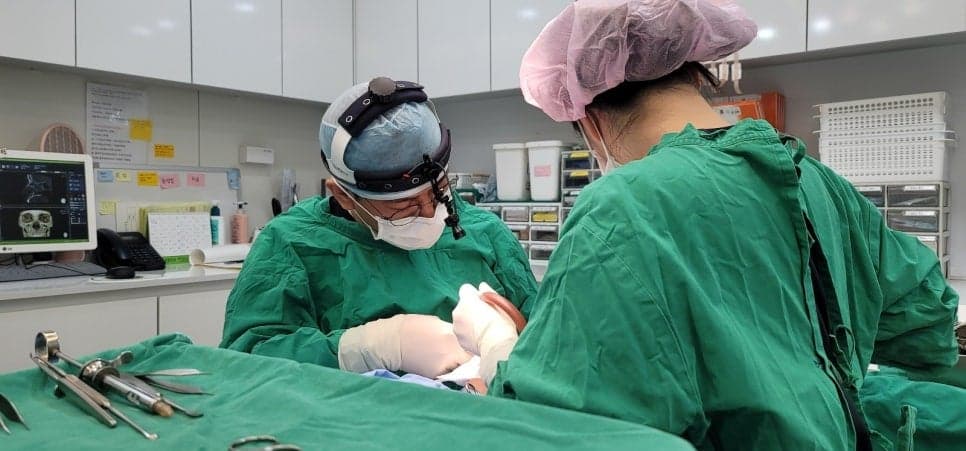
- Proportion and angle have many parts hard to judge from photos alone — a process of consulting while directly viewing facial structure is needed.
"Doctor, can you make a natural nose that doesn't look operated on?"
The story heard most often in nose-surgery consultations lately is the concern about naturalness. Recently, far more people want an angle and line that suit their face — rather than simply elevating and erecting — than those wanting a high nose. This article organizes three checkpoints that must be confirmed to make a natural nose, organized over 20 years of performing nose surgery.
01
Why shouldn't only the nose be pretty?
Many think 'if the nose is pretty, the whole face gets pretty too' — but this approach can conversely create an artificial feel. The nose sits at the face's center, so a wrongly designed one easily becomes an alien result.
For example, erecting an excessively high bridge on someone with a flat forehead can look more awkward with the forehead-nose line disconnected; if the tip rises too sharply, facial harmony mismatches and can give a 'done' impression. So rather than making the nose pretty detached, designing a nose that blends naturally within the face matters. For that judgment, the following three get read.
| Checkpoint | What gets read |
|---|---|
| ① Forehead-nose line flow | Whether the line running forehead-to-nose connects without breaking |
| ② Frontal proportion | Bridge width and tip shape fitting inter-eye distance·forehead line·cheekbone width |
| ③ Columella·nasolabial angle | The angle running below-nose-to-lips and the protrusive-mouth impression |
02
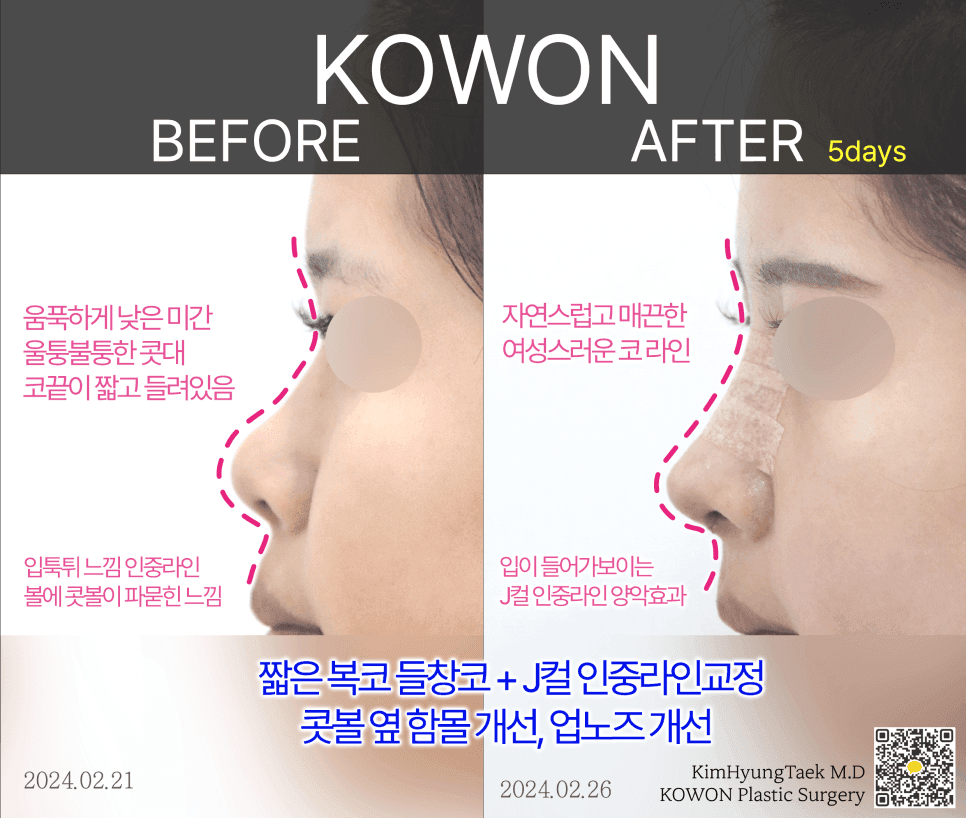
① Why is the line running forehead-to-nose read first?
The line naturally running forehead-to-nose is the starting point. If the nose looks like it's floating detached, it's because this flow didn't connect well.
So when designing a nose line, the forehead always gets examined first. For someone needing volume, harmony gets matched by combining other methods; for someone whose forehead is already dimensional, a nose line naturally supporting that curve gets planned. Just catching this flow well can produce the impression 'can't tell what changed but looks refined.'
03
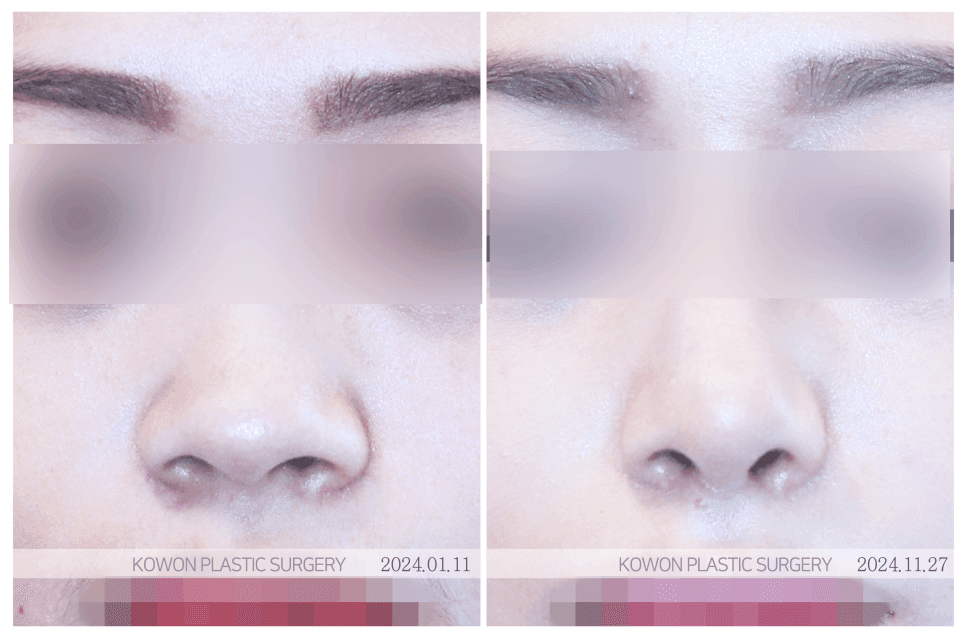
② What gets checked in frontal proportion?
Lately there's a mood preferring a slim bridge — but narrower isn't unconditionally better. Too narrow can make the impression look strong; too wide can make the face look spread. So considering inter-eye distance, forehead line, even cheekbone width, the bridge width fitting your face shape gets decided.
Same for tip shape. Making only the tip pretty doesn't revive the whole image — how it harmonizes with the face shape matters more.
- Roundish face but the tip erected too pointed → the impression can conversely look sharp
- Long face choosing a sock-nose shape dropping roundly → can look stuffy or dated
So the design takes a slightly raised curve form as the base so a harmonious feel comes through in frontal view. What gets checked at the tip can be seen in more detail in the tip surgery guide.
04
③ How does the nasolabial angle relate to protrusive-mouth impression?
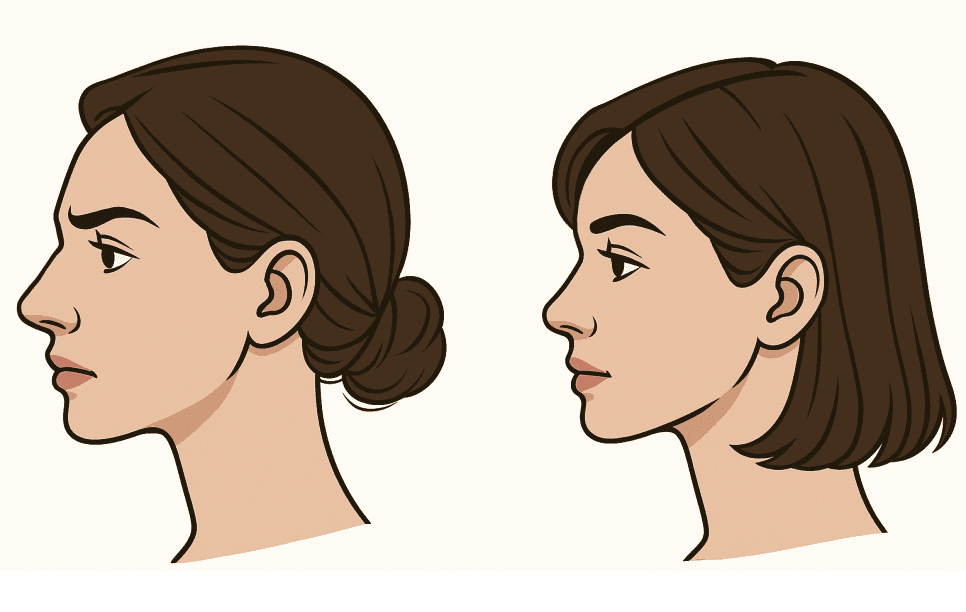
If the nasolabial angle is narrow or the columella sits inward, the mouth can look relatively more protruded — so the flow running below-nose-to-lips gets checked together.
The nasolabial angle is the angle running below-nose-to-above-lips. If this angle is too narrow and sharp, the mouth can feel more protruded in profile. Conversely, adjusting this area's angle well can help the mouth look less protrusive and the face look softer. For someone bothered by protrusive mouth in profile, it's worth checking whether a nasolabial-angle-centered structural approach is a method fitting them.
05
Summary — naturalness is a matter of flow·proportion·angle
A natural nose isn't just a high or slim shape — it's a line with dimensionality and flow fitting your face. Reading all three together — forehead-to-nose flow, frontal proportion, and nasolabial angle — gets closer to a result without a surgical look.
If curious which line fits your face, it can be diagnosed in advance in a 1:1 video consultation. Actual cases can be seen in the before & after photos.

Frequently asked questions
Answers to common questions patients ask before a consultation.
No. Erecting an excessively high bridge on someone with a flat forehead can look conversely awkward with the line disconnected. Before height come the forehead-nose line's flow and whole-face proportion.
A merely narrow bridge can make the impression look strong. Deciding a width fitting your face shape while considering inter-eye distance·forehead line·cheekbone width is the criterion of naturalness.
Not easily. Judging proportion and angle has many parts unknowable from photos alone — a process consulting while directly viewing face and structure is needed. If visiting is hard, it can also be checked via 1:1 video consultation.
Responses to treatment and recovery progress vary by individual. Outcomes and side effects vary from person to person. Bleeding, infection, swelling and asymmetry may occur. Please consult our medical team before making a decision.
Consultation