
KOWON Blog
Male rhinoplasty line design and recovery flow seen through a hump-nose case
Male rhinoplasty needs line-flow design running bridge to tip more than height. Surgery method seen through a hump-nose case, limits of bent nasal-bone correction, and the per-stage recovery course (week 1 · weeks 2–3 · months 1–3) when osteotomy went together — organized.

Key points
- Male rhinoplasty isn't simply making height — designing the whole line's flow together without separating bridge and tip matters.
- A hump nose isn't solved by removing the protrusion alone — line organizing considering straight-curve balance plus tip-direction adjustment are needed together.
- Recovery in this case, where osteotomy went together, flowed roughly: peak swelling week 1 → daily life possible weeks 2–3 → settling naturally over months 1–3.
When looking into male rhinoplasty, people commonly search 'where does it well' first. But to find that answer, you must first know what makes a good result. Especially for types like a hump nose where bridge line and tip direction act together — and impression differences show largely in before/after — what criteria the design uses matters.
Through a male nose case that gave a strong impression from a protruding hump and uneven bridge line, this article organizes in what order the line gets designed and what flow recovery follows.
01
What is the criterion for 'doing it well' in male rhinoplasty?
Designing the whole flow together rather than reading bridge and tip separately. For hump noses especially, simple removal alone falls short — line organizing considering straight-curve balance is the key. Balancing between naturalness and maintaining one's own image matters.
This case too was a type giving an overall strong impression from a protruding hump plus uneven bridge line. Organizing only the hump area isn't sufficient then — an approach considering the bridge's flow and tip direction together is needed.
02
How did surgery proceed?
- Hump organizing — the protruding hump was organized to smooth the bumpy bridge line, designed to continue around a non-excessive straight line reflecting male hump-nose traits
- Dorsal width — wide dorsal width was adjusted via osteotomy
- Tip — tip height was supplemented using septal cartilage; height and angle were adjusted to soften the strong-looking impression while balancing to keep a masculine image
- Side line — organized so the flow runs naturally bridge-to-tip in profile too, considering the columella·nasolabial angle·philtrum line connection
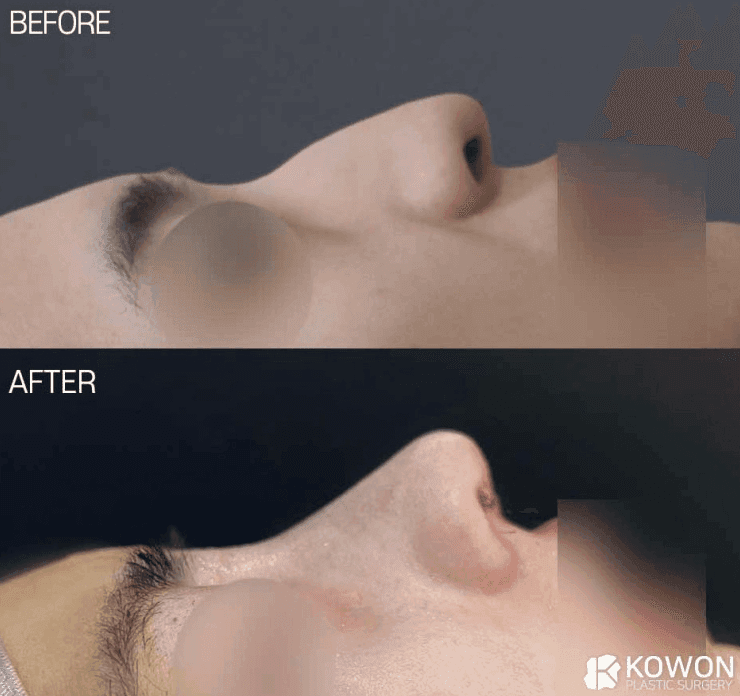
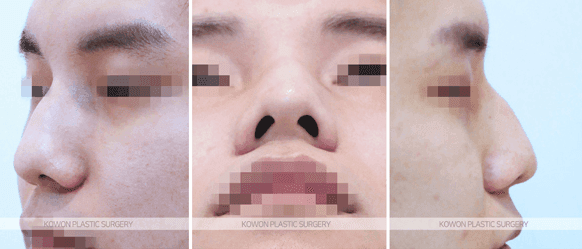
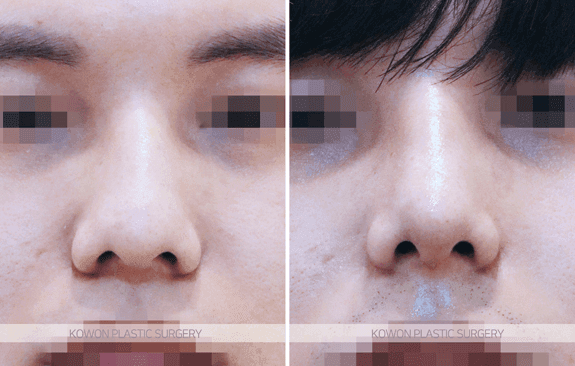
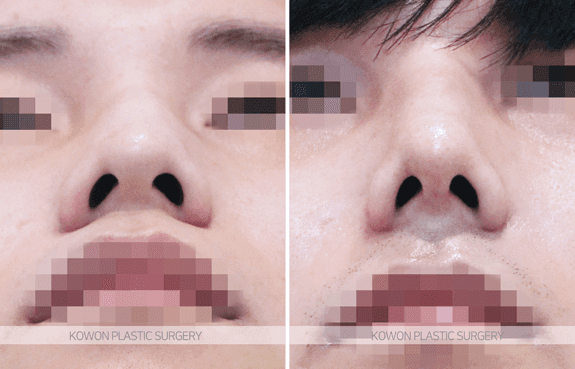
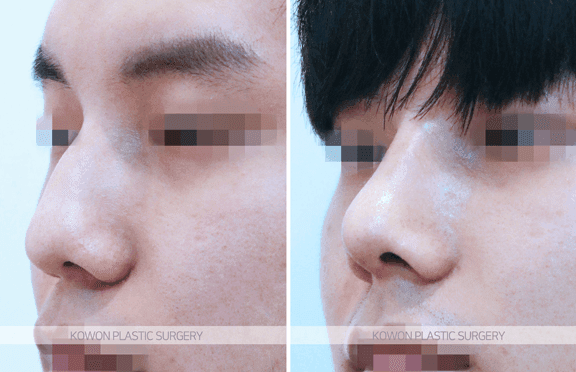
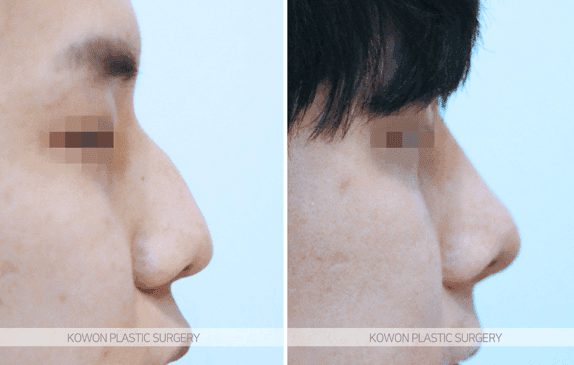
As a result, the protruding hump organized and the bumpy bridge line ran smoothly; the tip direction adjusted together, softening the whole impression. At 45 degrees the direction change of the once downward-dropping tip was confirmed, and in profile the smoothed dorsal line. Actual line changes can be seen in the before & after photos.
03
Does a bent nasal bone get fully straightened?
In this case the nasal bone tilted wholly to one side at the front, and viewed from below it was comparatively largely deviated. In such cases the direction proceeds by maximally straightening bone alignment — but structurally, part can tend to return over time, so sufficient advance explanation is needed. Post-op, the tilted form organized considerably and change to a more stable line was confirmed.
04
What flow does recovery follow?
Right after surgery is a stage before swelling sets in earnestly — a point where the formed bridge, tip line, and whole structure can be confirmed relatively clearly. It then organizes gradually softer over recovery.
| Period | State |
|---|---|
| Week 1 | Swelling most pronounced — too early to judge form |
| Weeks 2–3 | Swelling gradually eases — daily life possible |
| Months 1–3 | Tissue stabilizes, settling into a natural form |
The flow above is the course when osteotomy went together like this case — it can differ by correction scope. Early on the line flow shows relatively sharply, but over time tissue stabilizes into a more natural finish. Results can differ by individual skin state and structure — judging after sufficient recovery is appropriate. Per-stage care methods are organized in the rhinoplasty recovery guide.
05
Summary — ask how the flow gets designed
When choosing a male rhinoplasty clinic, checking how the flow running bridge-to-tip gets designed helps more than height or a specific area's correction amount. How hump organizing·osteotomy·tip adjustment·side-line connection mesh within one plan — and whether structurally limited parts like a bent nasal bone get explained in advance — become the grounds for judgment.
If curious what state your nose's hump and line flow are in, you can confirm directly in a 1:1 video consultation.

Frequently asked questions
Answers to common questions patients ask before a consultation.
A hump protruding in profile is handled by organizing the protruding part — but when dorsal width is wide at the front making the whole nose look big, width-narrowing osteotomy gets considered together. Meaning the profile line and frontal width get checked separately, then how much to include gets decided.
Since male nose surgery values line detail and balance, a design process based on diverse case experience is needed. At consultation, checking how they set the flow running bridge-to-tip helps.
Early on the line shows relatively sharply, but over 1–3 months tissue stabilizes into gradually more natural form. Since it can differ by individual skin state and structure, judging after sufficient recovery is appropriate.
Responses to treatment and recovery progress vary by individual. Outcomes and side effects vary from person to person. Bleeding, infection, swelling and asymmetry may occur. Please consult our medical team before making a decision.
Consultation