
KOWON Blog
Why does RIBFIT™ come up in male revision rhinoplasty — differences from autologous rib cartilage and comparison criteria
Types that bring men back to revision rhinoplasty — silicone inflammation, contracture, show-through — plus differences between autologous rib cartilage (block) and RIBFIT™ (fine-particle compressed, 3D-designed autologous-tissue implant), when RIBFIT™ can be compared, and revision clinic selection criteria — organized.

Key points
- Male revision rhinoplasty after silicone inflammation, contracture, or show-through isn't a 'little higher' problem — it's surgery where structure restoration comes first — so material choice matters much more.
- Autologous rib cartilage is a strong-support reconstruction material in block form, while RIBFIT™ is an autologous-tissue implant concept — rib cartilage ground into fine particles and compressed into a 3D-designed frame — choice differs by nose state and reconstruction scope rather than one being better.
- With 2+ applicable items — artificial-implant side effects, contracture, skin show-through worry — materials can be compared concretely.
"I'm looking into male revision rhinoplasty… I got silicone and had inflammation. This time I want to switch to autologous, but I don't quite know what RIBFIT™ is."
Many people say this. Where the first surgery's concern was height and shape, now anxiety comes first — because they've experienced silicone inflammation, an upturned tip, thinned-feeling skin, or feel structural instability.
This article organizes why RIBFIT™ gets mentioned in male revision rhinoplasty, and the criteria for how it differs from autologous rib cartilage.
01
In which types does male revision rhinoplasty get reconsidered?
Male noses differ somewhat from female noses. Skin is often thick with developed sebaceous layers, so fine changes don't show outside — while when structure collapses, it shows much bigger. And since many prefer straight, firm lines, even slight lifting or bending easily changes the impression.
Types of those coming in for revision split as follows.
- Silicone show-through
- Inflammation experience
- Tip upturned by contracture
- Bent bridge
- Columella instability
- Thinned skin
Such cases aren't a 'little higher' problem. Since the nose's internal structure has already been damaged once, revision is structure restoration first, not shape. Especially if you've experienced artificial-implant side effects, material choice should be reviewed more carefully this time.
02
What differs between autologous rib cartilage and RIBFIT™?
First, autologous rib cartilage is the cartilage at the rib's end. With sufficient quantity and strong support, it's a material heavily used to re-raise collapsed noses — important in reconstruction surgery. But since it's used in block form, warping can rarely occur — affected by the surgeon's processing method and skill.
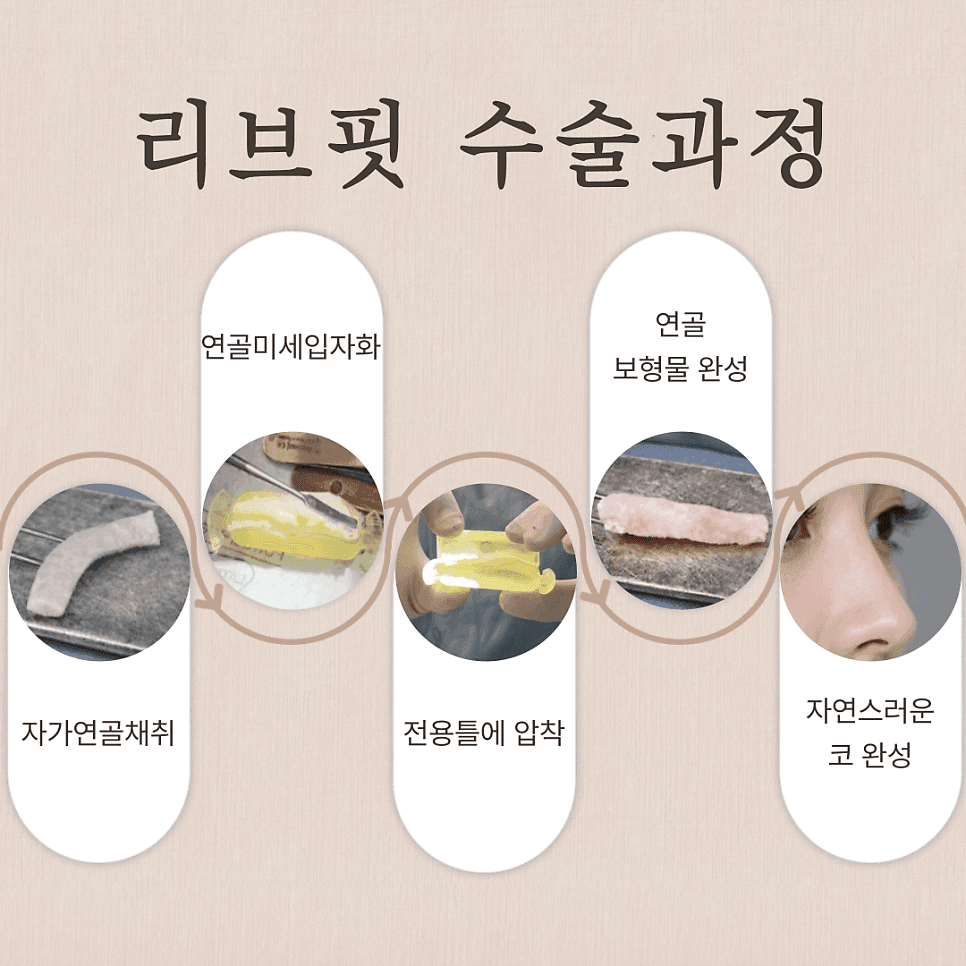
RIBFIT™ is an autologous-tissue implant concept for replacing silicone. Rather than inserting rib cartilage as-is, it grinds it thin into fine particles, then compresses into a 3D-designed frame to create an autologous-tissue implant with form. Meaning it uses autologous rib cartilage while dispersing it into a fine-particle structure and pre-planning form via 3D design — approaching an implant-free concept. That's why it gets mentioned as an alternative among those who've experienced artificial-implant side effects. Method details can be seen in the RIBFIT™ autologous-tissue implant guide.
| Category | Autologous rib cartilage | RIBFIT™ |
|---|---|---|
| Form | Block | Fine-particle compression |
| Design | Processed during surgery | 3D-design based |
| Concept | Autologous cartilage graft | Autologous-tissue implant |
| Direction | Support-focused | Support + form planning |
Rather than one being better, choice differs by nose state and reconstruction scope.
03
When can RIBFIT™ be compared?
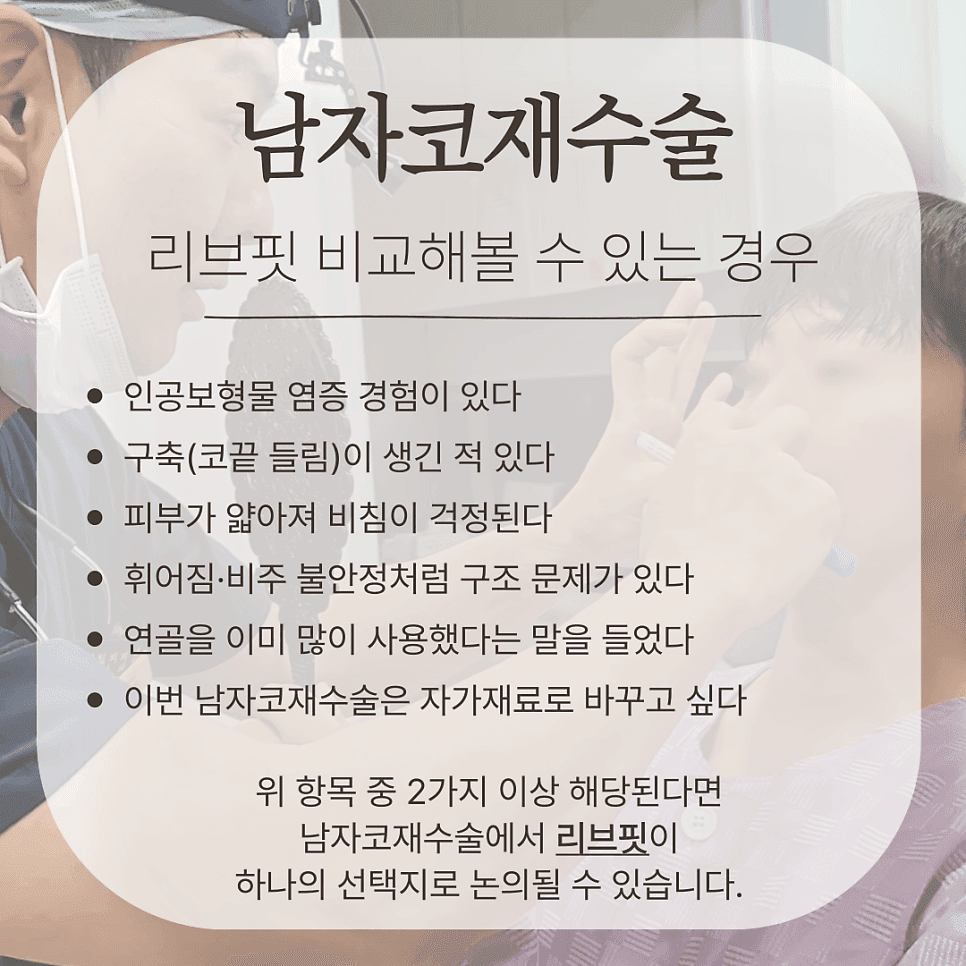
What matters in male revision rhinoplasty isn't how much height can go up, but how the current structure gets stabilized. If 2+ of the items below apply, materials can be compared concretely.
- 01You've experienced artificial-implant inflammation
- 02Contracture (upturned tip) has occurred
- 03Skin has thinned and show-through worries you
- 04Structural problems exist like bending or columella instability
- 05You've heard a lot of cartilage was already used
- 06You want to switch to autologous material this revision
In such cases, RIBFIT™ can be discussed as one option in male revision rhinoplasty.
04
When you want this to be the last — what should you look at in a clinic?
Revision differs from first surgery. Adhesions must be released and structure reorganized — so analysis and focus matter. When choosing a clinic, referencing the criteria below helps.
- Whether they accurately analyze current nose structure and adhesion state
- Whether they concretely explain material-selection criteria
In revision, criteria matter more than results. How accurately your current nose state gets read and designed to fit should be looked at first — checking judgment criteria before design is good. Pre-revision check items are also organized in the revision guide.
05
Summary — structure over design, stability over height
In male revision rhinoplasty, structure restoration comes first; autologous rib cartilage and RIBFIT™ differ in selection by nose state and reconstruction scope; and analysis plus focus matter. If you've experienced silicone side effects, becoming anxious is natural — but think stability before design, structure before height.
If curious about criteria for which material fits your nose state, it can be sorted in a 1:1 video consultation.




Frequently asked questions
Answers to common questions patients ask before a consultation.
No. RIBFIT™ can't be declared the answer outright — depending on nose state and reconstruction scope, the autologous rib cartilage block method may fit. With 2+ applicable items like artificial-implant side effects, contracture, or show-through worry, comparing materials concretely and sorting criteria for which fits your nose is the order.
Since autologous rib cartilage is used in block form, warping can rarely occur — affected by the surgeon's processing method and skill. RIBFIT™ disperses rib cartilage into fine particles compressed into a 3D-designed frame — different in that form gets pre-planned. Either way it's a choice depending on reconstruction scope and structure state.
Male noses often have thick skin with developed sebaceous layers, so fine changes barely show — while collapsed structure shows bigger. With high preference for straight lines, even slight lifting or bending easily changes the impression — making adhesion release and structure-reorganizing analysis and focus more important.
Responses to treatment and recovery progress vary by individual. Outcomes and side effects vary from person to person. Bleeding, infection, swelling and asymmetry may occur. Please consult our medical team before making a decision.
Consultation