
KOWON Blog
Can a man's big nose be reduced surgically — why spread nasal bones and a blunt tip get read separately
A male big-nose concern — fine in profile but big from the front. Why spread nasal bones go to osteotomy and a blunt tip to tip surgery as separate judgments, plus surgery's limits — organized from an actual inquiry.

Key points
- A male big-nose concern isn't "the whole nose is big" — it's which part looks big and how. Some look big only from the front despite a fine profile.
- Spread nasal bones can be reviewed via osteotomy reducing the bone, and a blunt tip via tip surgery — separately.
- Male big-nose surgery does have limits, so confirming through examination whether the area you want improved falls within surgery's solvable range comes first.
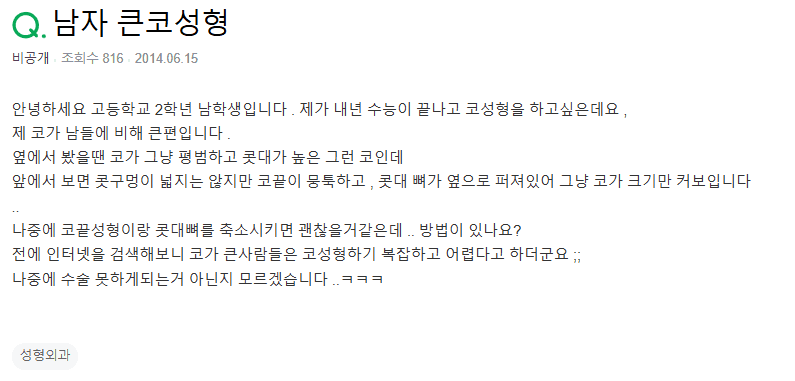
"From the side my bridge is actually on the high side, but from the front the tip is blunt and the bridge bone feels spread sideways. It seems like a typical male big nose — is there a chance of improvement with surgery?"
An inquiry from a 2nd-year high school boy planning rhinoplasty after the CSAT. The internet is full of "male big noses are complicated and hard to operate" talk, so his worry was large.
Based on the answer to that inquiry, this article organizes the framework for dividing and judging a male big nose.
01
Why divide which part of a big nose looks big?
Because the surgery reviewed differs by nasal-bone width and tip form. First, divide which parts look big in profile versus front.
- Profile — the nose is ordinary; the bridge is rather high
- Front — nostrils aren't wide, but the tip is blunt and the bridge bone feels spread sideways
Lumping it into the single word "big nose" makes surgery feel vague and difficult — but dividing it this way makes what to confirm clear. The approach differs depending on whether the cause of looking big is bone width or tip form.
02
How do spread nasal bones and a blunt tip improve?
The direction reviewed: narrow the width of sideways-spread nasal bones via osteotomy, and trim a blunt tip's form via tip surgery.
| Concern area | Improvement direction |
|---|---|
| Nasal bones wide sideways | Improvable via **osteotomy** reducing the bones |
| Blunt tip | Improvable via **tip surgery** |
Sideways-wide nasal bones can improve through osteotomy that reduces the bones. And a blunt tip can also be trimmed surgically. What gets confirmed in tip correction can be seen in more detail in the nasal tip plasty guide.
03
"Male big noses are hard to operate" — how true is that?
With male big noses, surgery having limits is true. A nose can't be made infinitely small.
But what matters is whether the part you want improved falls within surgery's solvable range. With a goal like this inquiry's — "reduce the sideways-spread nasal bones and trim the blunt tip" — it's a part reviewable through osteotomy and tip surgery, so there's no need for excessive worry. Actual improvement cases can be confirmed in the before & after photos.
Organized, the judgment order is as follows.
- 01Divide which parts look big — bone width or tip form
- 02Check the possible surgical method per part — osteotomy, tip surgery, etc.
- 03Confirm through examination whether the desired improvement falls within surgery's solvable range
04
Summary — part-by-part confirmation over vague worry
Facing the vague talk of "male big noses are difficult," worry easily grows. But divide the cause of looking big into bone width and tip form, and each has a reviewable method — osteotomy and tip surgery. Since surgery having limits is true, the starting point is confirming through examination whether your desired improvement sits within that range.
If curious which part of your nose looks big, you can confirm directly in a 1:1 video consultation.
Frequently asked questions
Answers to common questions patients ask before a consultation.
Limits existing is true — but spread nasal bones can be reviewed via osteotomy and a blunt tip via tip surgery. Confirming through examination whether the area you want improved falls within surgery's solvable range comes first.
In this inquiry's case, the cause wasn't bridge height but the sideways-spread bone width and blunt tip. In such cases, rather than changing height, the direction is set via osteotomy reducing bone width plus tip correction. The exact cause gets confirmed in examination.
Surgery that reduces sideways-wide nasal bones. It's the method reviewed for improvement when the bridge bone looks spread from the front.
Responses to treatment and recovery progress vary by individual. Outcomes and side effects vary from person to person. Bleeding, infection, swelling and asymmetry may occur. Please consult our medical team before making a decision.
Consultation