
KOWON Blog
If ear cartilage shows through the tip after silicone removal — when you worry it might protrude or necrotize
Why ear cartilage still shows through the tip after silicone removal — it may be skin thinned during the silicone period rather than cartilage pushing out. The possibility of necrosis or protrusion and the options when it bothers you, organized from an actual consultation answer.

Key points
- Ear cartilage showing through the tip after silicone removal may not be cartilage pushing out — it can be the effect of tip skin thinned during the period silicone was present.
- Show-through alone doesn't necessarily mean protrusion or skin damage — but risk can't be entirely ruled out either, so skin changes and cartilage position need direct checking.
- If removal is needed, the access range is decided after examining skin thickness, adhesion, and the existing cartilage's role.
"My nose currently has no silicone — only ear cartilage. Can the cartilage protrude? Could it necrotize or get worse later because of this?"
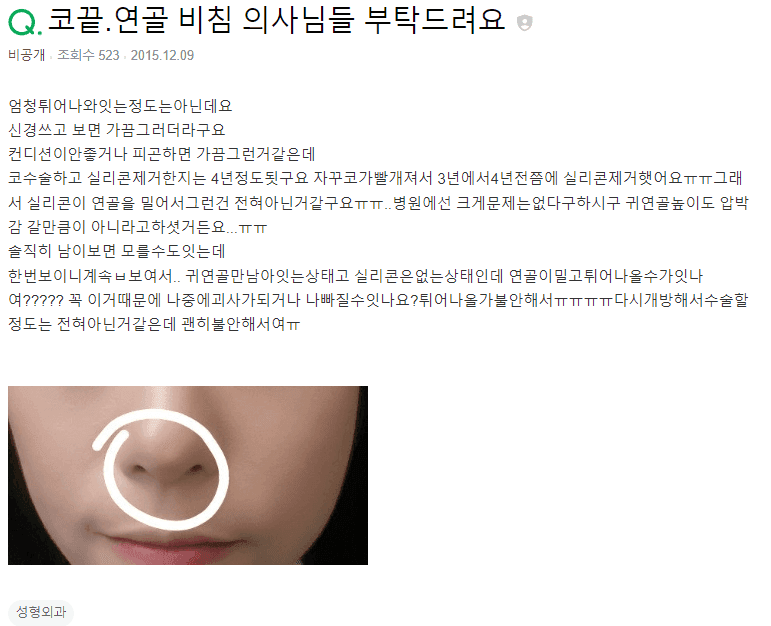
This is an actual consultation question from someone concerned about cartilage issues after rhinoplasty. Their nose kept turning red after surgery, so they had the silicone removed 3–4 years ago — but the tip cartilage bothers them when their condition is off or they're tired. The clinic told them there was no major problem and the ear cartilage height wasn't at a level that would feel like pressure — yet once they noticed it, they kept seeing it and felt anxious.
This article organizes the answer to that question.
01
The silicone was removed — why does ear cartilage show through?
The asker's state looked like ear cartilage faintly showing through the tip.
In this case, the possibility can be considered that the ear cartilage contour shows more because of skin changes from the period when silicone was present. Still, the degree of skin thinning, the cartilage's position, and the adhesion state can't be pinned to a single cause without direct examination.
Organized, they can be distinguished like this.
| The worried situation | The explanation closer to reality |
|---|---|
| Ear cartilage is pushing out the tip | Not cartilage pushing — a state where it shows through over thinned skin |
| The cartilage will gradually protrude | Show-through alone doesn't mean protrusion, but skin changes and cartilage position need checking |
| It could lead to necrosis | Risk can't be ruled out from photos alone — get care if there's redness, pain, or a wound |
02
Can ear cartilage pierce through the skin or necrotize?
Show-through alone can't be taken to mean cartilage exposure or skin damage is imminent. Conversely, remote Q&A without photos can't entirely rule out future risk either.
The clinic that already examined them had confirmed there was no major problem and the cartilage height wasn't at a level to feel like pressure. If it's less "sticking out" and more "occasionally visible when you pay attention, noticeable when your condition is off or you're tired," it's hard to see as a situation requiring immediate open surgery.
Still, there's a premise — as long as no inflammation develops. If changes suggesting inflammation appear, like the tip reddening, hurting, or swelling, then getting care to check the state is the safe move.
03
If the show-through keeps bothering me, what options exist?
Others may not notice it, but once you start seeing it yourself it keeps catching your eye and can become bothersome.
If removal is needed, an intranasal approach can be considered — but it can't be guaranteed to always end at a small scope. The access range must be set after checking skin thickness, adhesion, and what role that cartilage plays in tip support. If there's no functional problem it isn't a mandatory surgery, so decide by distinguishing danger signals from daily-life inconvenience. How revision is judged from a nasal state after silicone removal can be seen further in the revision rhinoplasty guide.
04
Summary — show-through and protrusion are different
When ear cartilage shows through the tip after silicone removal, skin thickness, cartilage position, and adhesion state have to be checked together. Show-through alone doesn't necessarily mean protrusion or skin damage — but risk can't be ruled out remotely either. Don't rush into revision out of anxiety alone; if changes like redness, pain, or wounds appear, get care early. Whether to remove and the access range are also decided after direct examination.
If you're curious which side your tip state falls on, you can get it checked directly in a 1:1 video consultation.
Frequently asked questions
Answers to common questions patients ask before a consultation.
It's not the cartilage itself growing and protruding — it's the cartilage contour inside showing through in a state where tip skin has thinned. In this case, the cause looked to be tip skin thinned during the period silicone was present.
Show-through alone doesn't mean protrusion or skin damage — but future risk can't be entirely ruled out either. If the tip reddens or hurts, or the skin peels or discharge appears, get care without delay.
Removal isn't necessarily required. When removal is needed an intranasal approach can be considered — but the scope differs by skin, adhesion, and tip support state, so it must be set after direct examination.
Responses to treatment and recovery progress vary by individual. Outcomes and side effects vary from person to person. Bleeding, infection, swelling and asymmetry may occur. Please consult our medical team before making a decision.
Consultation