
KOWON Blog
5 Months After Rhinoplasty, My Nose Looks Bumpy — Do I Need Revision? The Order of Checking When Worried
An answer to a question about feeling bumpiness at the silicone edge and alar area 5 months after rhinoplasty with donor rib cartilage — the judgment that revision didn't look necessary from photos, and guidance to discuss with the operating clinic if it still bothers you.

Key points
- Feeling bumpiness after rhinoplasty doesn't immediately mean revision. In this question, the shape looked good in photos and revision didn't appear necessary.
- Still, if it keeps bothering you, visiting the operating clinic and consulting the surgeon who operated comes first.
- Online photos have limits for confirmation — checking in person is the order, rather than letting worry grow alone.
"It's been 5 months since my rhinoplasty, and at some point my nose seems to have become bumpy. Do I need a revision?"
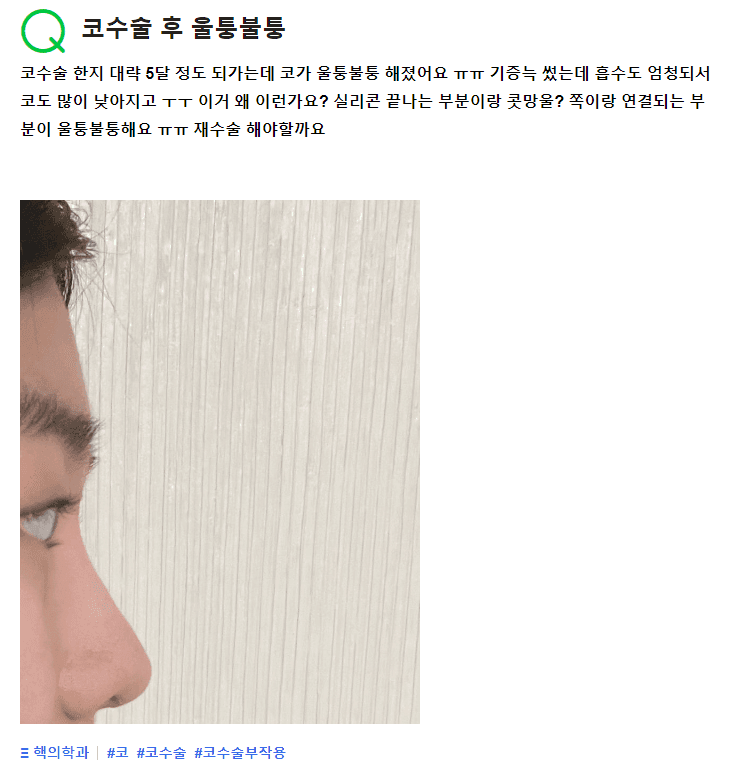
A question covered in an actual consultation answer. The person had rhinoplasty using donor rib cartilage, and at the 5-month point felt bumpiness where the silicone ends and around the alar area. Along with that was a worry that the donor rib had absorbed too much and the nose had become much lower. Without knowing exactly when it started, once the feeling began, the stress grew.
This article organizes the answer to that question.
01
If the nose feels bumpy, should I think about revision right away?
The answer to this question was that it's not so. Looking at the attached photos, the shape looked good and revision didn't appear necessary.
What the bumpiness the person felt was caused by was hard to determine from photos alone. However, if no problem requiring revision is visible in the outward shape, there's no reason to decide on revision based on feeling alone. General criteria for when to consider revision are covered in the revision guide.
| The person's worry | Answer |
|---|---|
| Silicone edge & alar area feel bumpy | Shape looks good in photos — cause hard to determine from photos alone |
| Do I need revision | Doesn't appear necessary |
| If it still keeps bothering me | Visit the operating clinic and consult the surgeon |
02
What if it keeps bothering me anyway?
Even if the photos look fine, the discomfort the person feels doesn't disappear. So the answer also advised: if it bothers you a lot, visit the clinic where you had surgery, get a consultation from the operating surgeon, and discuss it.
The order organized is as follows.
- 01Don't judge alone — rather than growing worry by guessing the cause of the bumpy feeling,
- 02Visit the operating clinic — show your condition directly to the surgeon who knows the procedure best,
- 03Discuss after consultation — talk together about whether any measures are needed based on the findings.
The state of the surgical area can be known accurately only by direct examination. Online answers can judge only within what's visible in photos, so final confirmation belongs to in-person care.
03
Summary — checking comes before feeling
When months pass after rhinoplasty and the nose feels bumpy, revision comes to mind first. But as in this question, there are cases where the photos look good and revision doesn't seem needed. If the worry continues, confirming the state and discussing it at the operating clinic comes first, rather than growing the concern alone.
If you're worried about postoperative progress or your nose's condition, it can be checked directly in a 1:1 video consultation.
Frequently asked questions
Answers to common questions patients ask before a consultation.
It can't be concluded from feeling alone. In this question, the photos looked good and revision didn't appear necessary. However, since the exact state must be confirmed by direct examination, if it keeps bothering you, getting it checked at the operating clinic is best.
It isn't decided by felt bumpiness alone. In this case, revision didn't appear necessary from photos, and the guidance was to consult and discuss with the operating surgeon if worry remained.
Online consultations or another clinic's opinion can be a reference, but in this answer too, the priority was visiting the clinic that operated — because the surgeon who knows the procedure checking the state directly is most accurate.
Responses to treatment and recovery progress vary by individual. Outcomes and side effects vary from person to person. Bleeding, infection, swelling and asymmetry may occur. Please consult our medical team before making a decision.
Consultation