
KOWON Blog
Autologous Cartilage Nose Surgery — Why Structure Is Viewed First: The Three Cartilage Types and How to Choose a Clinic
Why autologous cartilage rhinoplasty can reduce worries about foreign-body reaction and visible lines; the traits and limits of septal, ear, and autologous rib cartilage; and the criteria for choosing a clinic that designs support structure before appearance.
Key points
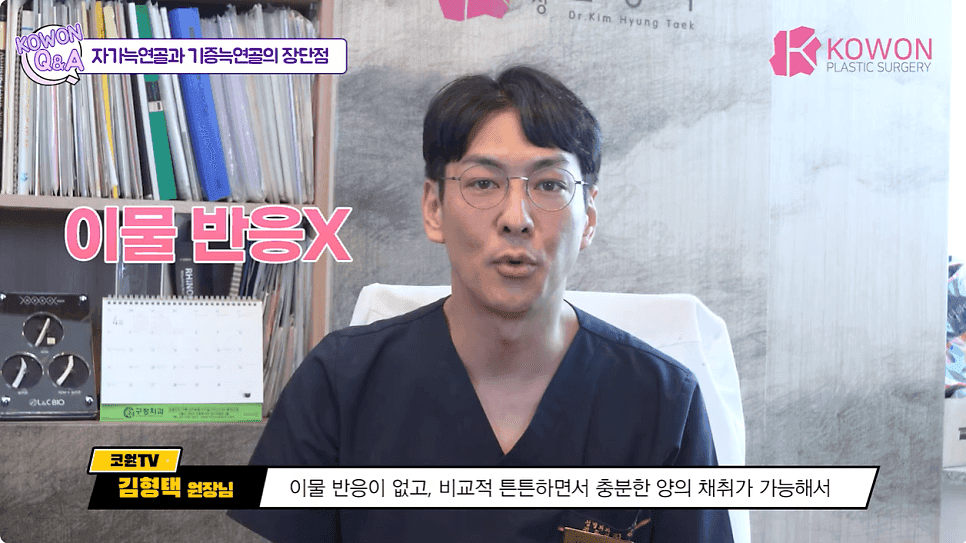
- Autologous cartilage rhinoplasty uses your own tissue, so foreign-body reaction is nearly absent and inflammation risk is low compared to artificial implants.
- Autologous cartilage also has three types — septal, ear, and autologous rib — differing in support, harvestable quantity, and flexibility, so their roles differ.
- When choosing a clinic, what to check is whether it designs support structure and stability first, ahead of appearance.
"I heard about autologous cartilage nose surgery — how is it done?" "My silicone shows through and looks too unnatural."
Things we hear often in the consultation room. As more people want natural, long-lasting results, interest in autologous cartilage is rising. Autologous cartilage rhinoplasty is a method that rebuilds the nose's shape and structure using one's own cartilage — a surgery that builds not just the exterior but the collapsed internal structure.
This article organizes what kind of material autologous cartilage is, how the cartilage types differ, and by what criteria to evaluate a clinic.
01
How does autologous cartilage differ from artificial implants?
Materials used in rhinoplasty divide broadly into artificial implants like silicone and Gore-Tex, and autologous tissue. The starting point of autologous cartilage is that because it is your own tissue, the body does not recognize it as a foreign substance.
- Almost no foreign-body reaction — inflammation risk is low, and it is favorable for maintenance over long periods. It can be a more suitable choice for people sensitive to immune reactions or who have had problems with past implants.
- Shows through less — while implants like silicone can show borders under light or reveal a silhouette under thin skin, autologous cartilage fuses naturally with surrounding tissue so borders rarely show even under thin skin.
The full picture of each material's pros and cons can be seen together in the materials guide.
02
How do the three autologous cartilage types differ?
Not all autologous cartilage is the same. Properties and roles differ by harvest site.
| Type | Traits | Limits |
|---|---|---|
| Ear cartilage | Soft with good flexibility | Weak force holding structure — can compress over time, so shape maintenance is difficult when used alone |
| Septal cartilage | Harvested inside the nose; relatively firm, used to build the columellar strut at the nose's center | Limited quantity — can droop or weaken over time |
| Autologous rib cartilage | Strong against vertical pressure — favorable for keeping the tip from easily lifting or drooping | — used broadly from tip extension to strut roles |
In short, where flexibility is needed, where a center must be raised, and where load must be borne differ — and the fitting cartilage differs accordingly. How autologous rib cartilage is used can be seen in more detail in the autologous rib guide.
03
What should a clinic be chosen by?
Autologous cartilage rhinoplasty is not a surgery that trims the shape — it is a surgery that rebuilds the nose's structure and must maintain stability over a long time. So the criterion to examine is not the glamour of result photos but the design approach.
- 01Is there a structure-centered philosophy — pretty shape matters, but if the supporting framework collapses it can revert over time. Check whether support structure and stability are designed before appearance.
- 02Is analysis done across the whole face — check whether the nasolabial angle (the angle between nose and upper lip), septum, skin thickness, and so on are viewed together to reconstruct the whole structure.
- 03Is the surgical process transparently disclosed — because "does the director really operate personally?" is a frequent question, we disclose the whole surgical process by CCTV and take direct responsibility for the entire process.
For the same reason, we perform only 2 surgeries a day. We believe that what determines a result that holds over time is not the visible shape but how honestly the structure inside was designed and operated.
04
Summary — look at the design, not the material's name
The strength of autologous cartilage rhinoplasty lies not in the name "autologous cartilage" itself but in the ability to rebuild a collapsed structure while reducing the burden of foreign-body reaction. Even within the same autologous cartilage, which cartilage is used where and whether support structure is designed first changes how the result holds. A consultation that asks how the structure is designed is needed, rather than only checking the material's name.
If you are curious about the material and design fitting your nose, it can be checked in a 1:1 video consultation.


Frequently asked questions
Answers to common questions patients ask before a consultation.
Because it is your own tissue, the body does not recognize it as foreign — so foreign-body reaction is nearly absent and inflammation risk is low. It can be a suitable choice especially for people sensitive to immune reactions or who have had implant problems before.
It depends. Ear cartilage is flexible but weak in support so shape is hard to maintain alone; septal cartilage is firm but limited in quantity. Depending on the support needed, autologous rib cartilage strong against vertical load is also used.
It helps to see whether support structure and stability are designed before appearance, whether the whole face is analyzed including nasolabial angle, septum, and skin thickness, and whether the surgical process is transparently disclosed with the operating surgeon directly responsible.
Responses to treatment and recovery progress vary by individual. Outcomes and side effects vary from person to person. Bleeding, infection, swelling and asymmetry may occur. Please consult our medical team before making a decision.
Consultation