
KOWON Blog
I Have a Bulbous Nose — Is Alar Reduction Alone Enough? Criteria for Telling Whether It's Only a Nostril Problem
Criteria for distinguishing when alar reduction alone suffices for a bulbous nose and when it hits limits. Covers a self-check list, the difference between non-incision and incision methods, and what to confirm when choosing a clinic.

Key points
- A bulbous nose is hard to pin down as a nostril-only problem — the thickness of the tip's soft tissue and the structure supporting the nose often play a role together.
- Alar reduction reduces the width that looks spread out from the front — it is not a surgery that creates tip height or a bridge line.
- There are cases where alar reduction alone suffices and cases with limits — so a process of first judging which category your nose falls into matters.
"I have a bulbous nose — is alar reduction alone enough?"
When photos taken from the front make the nose look wide and the center of the face feels stuffy, this is the first concern many people think of. When the nostrils look spread, you naturally search alar reduction first — but facing the actual decision, many wonder "is this the right choice?"
This article sets a bulbous nose and alar reduction side by side and organizes the criteria for what to look at when judging.
01
What state does "bulbous nose" refer to?
A bulbous nose easily gives the impression that the nostrils are spread sideways from the front, making the whole nose look larger and duller. In reality, though, not only the nostrils but also the thickness of the tip's soft tissue and the structure supporting the nose often play a role together. So rather than pinning a bulbous nose to a single cause, it is better understood as a state where several elements overlap.
If two or more of the items below apply, several elements may be working together on the bulbous impression.
- The nostrils look wide and spread from the front
- You often hear that the tip looks round and blunt
- The nose looks more stuffy from a low angle
- When smiling, the nostrils and tip feel like they spread together
02
What kind of surgery is alar reduction, and how is it divided?
Alar reduction is a surgery that tidies the impression by reducing the width or volume of nostrils that look spread out from the front. It mainly adjusts the outer skin of the nostril or the structure inside the nostril to fit the condition, narrowing the width that looked splayed sideways.
| Method | Content |
|---|---|
| Non-incision | Minimizes skin-surface incisions and adjusts width mainly inside the nostril |
| Incision | Incises as needed along the outer nostril line and directly organizes the spread structure |
Neither method can be flatly declared better — the suitable approach can differ by nostril thickness, degree of spread, and skin characteristics. Still, it helps to understand in advance that alar reduction reduces the width that looks spread from the front — it is not a surgery that creates tip height or a bridge line.
03
It seems like just reducing the nostrils would do — why do limits appear?
Because a bulbous nose often shows nostrils spread wide from the front, it's easy to think "wouldn't just reducing the nostrils do it?" In practice, though, there are cases where reducing only the nostrils leaves the nose's central flow looking broken and feeling more awkward instead. If the connection between bridge and tip is not natural, the nose may be smaller yet not look tidy.
That is why, for a bulbous nose, an approach that considers the flow running from bridge to tip to nostrils together — rather than viewing the nostrils alone — becomes necessary.
In this process, more people recently prefer autologous-tissue implants made from processed autologous rib cartilage instead of artificial implants, considering the burden of inflammation or foreign-body sensation. Our clinic has also applied RIBFIT™ RibFit — processing autologous rib cartilage into fine particles and crafting it into a shape fitting each person's nasal structure — since before this approach became a trend. Compared with using rib cartilage in its original form, the absorption rate is lower, and by replacing silicone, the possibility of inflammation is relatively low; the purpose is naturally connecting the nose's central line.
For these reasons it is also used together in cases like a bulbous nose that require structural judgment. The details can be seen in the RIBFIT™ RibFit guide. Still, this too is not a method everyone needs — there are clearly cases where alar reduction alone suffices. What matters is the process of first accurately judging which category your nose falls into.
04
By what criteria should I choose an alar-reduction clinic?
Alar reduction is often not a surgery that ends with simply reducing — it is frequently a case where the whole nasal flow must be reviewed and judged together. So when choosing a clinic, it matters to look at the explanation and judgment structure before the results.
- 01Whether there is long experience and know-how focused on noses
- 02Whether it is a 1:1 consultation that examines and judges your condition one item at a time
- 03Whether the structure limits daily surgery counts so attention stays on each patient
05
Summary — how far to change comes before what to reduce
A bulbous nose is hard to pin down as a nostril-only problem. There are cases where alar reduction alone suffices and cases with limits — so when choosing a clinic, looking at the explanation and judgment structure together matters. Before deciding what to reduce, a process of first organizing how your nose is being read and how far you want to change it is needed.
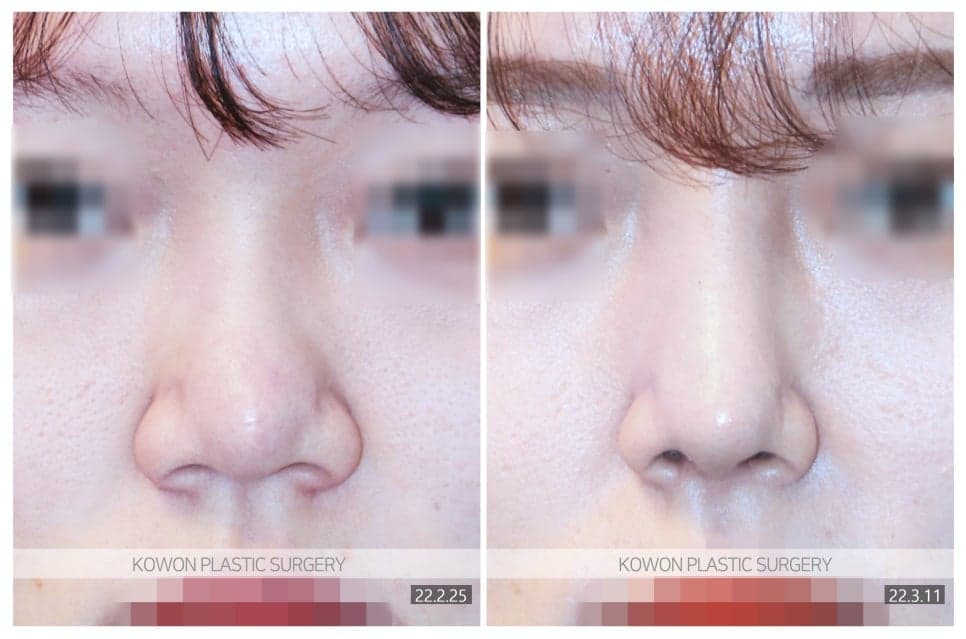
If you wonder whether your nose is a nostril-only problem, it can be confirmed in a 1:1 video consultation. Actual cases can be seen in the before-and-after photos.





Frequently asked questions
Answers to common questions patients ask before a consultation.
The width can be reduced — but if the bridge-to-tip connection is not natural, the nose may be smaller yet not look tidy. It matters to first distinguish whether it is a nostril-only problem or a state where the whole nasal flow should be read together.
Neither can be flatly declared better. Non-incision adjusts width mainly inside the nostril; incision directly organizes the spread structure along the outer nostril line. The suitable approach differs by nostril thickness, degree of spread, and skin characteristics.
No. Cases where alar reduction alone suffices clearly exist. Still, when the tip's tissue thickness and support structure also play a role, limits can appear if only the nostrils are reduced — so the range is set after first judging which category your nose falls into.
Responses to treatment and recovery progress vary by individual. Outcomes and side effects vary from person to person. Bleeding, infection, swelling and asymmetry may occur. Please consult our medical team before making a decision.
Consultation