
In my previous post, I explained that nasal bridge materials fall broadly into two groups: silicone and autologous tissue.
But within what is loosely called "autologous tissue rhinoplasty," there are several different methods, and the results vary greatly depending on the method.
Many people come to a consultation knowing only that they "decided on autologous tissue," yet which tissue is used and how it is processed actually makes a big difference.
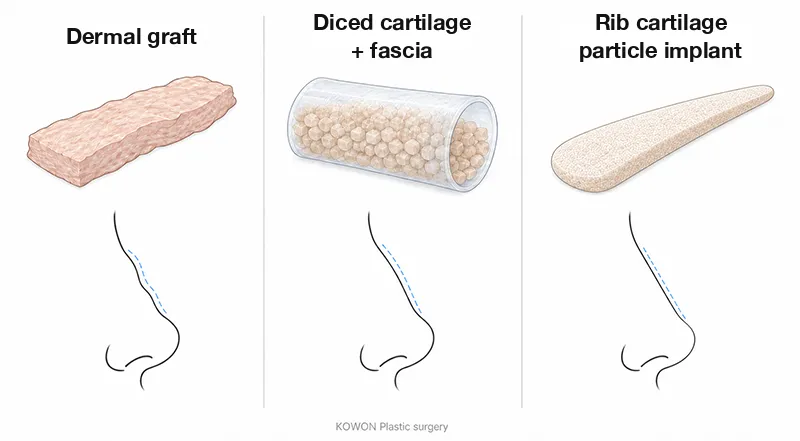
A dermal graft takes the dermis layer from the body and places it in the nasal bridge. Being your own tissue is a clear advantage, but I generally do not recommend it as a bridge material.
There are two reasons. Dermis is thick and blunt by nature, which makes it hard to create a refined bridge line, and above all, its absorption rate is hard to predict.
Absorption differs from patient to patient, and even in the same patient, if some areas absorb a lot and others less, the bridge becomes uneven.
If the surgery went well but the result is inconsistent, that is a limitation of the material, not of the surgeon's hands.
Diced cartilage (with fascia) is a method in which cartilage is finely chopped, wrapped in fascia and inserted.
Think of it as filling cartilage particles inside fascia, the way you roll gimbap.
It is absorbed less than dermis, but absorption still has to be factored in, and because it is a soft pouch, the line is not defined precisely.
There is also something patients often don't know: the absorption rate changes depending on how finely the cartilage is diced and how much of it is packed in.
This standard varies from clinic to clinic. That is why results differ even for the same "diced cartilage bridge." There is also the added burden of harvesting fascia separately.
A rib cartilage particle implant is made by processing rib cartilage into particles and pressing them into the shape of a nasal bridge implant before insertion.
The material is your own cartilage, yet the shape is refined like an implant.
What determines the result here is how finely the particles are processed. The finer the particles, the more cartilage is packed densely into the same volume when pressed, and the denser the tissue, the lower the absorption rate.
Above, I mentioned particle size as the reason diced-cartilage results differ between clinics; here the same principle works in the opposite direction.
How finely the particles are refined and how densely they are packed is, in effect, the quality of this surgery.
It is an approach that addresses, within a single material, two goals that were hard to achieve together: the engraftment and safety of autologous tissue, and the refined line of an implant.
To be honest, when this method came back to mind, I thought, "Eureka."
It was a method used mainly at university hospitals, and here was the answer to the dilemma I had weighed again and again over more than 20 years of nose surgery — the precision of silicone versus the safety of autologous tissue.
At the time, I was racking my brain over how to operate on a patient from abroad who had an autoimmune disease.
I still remember how I felt when I decided I could apply it to my patients.
These days there are many companies that make molds, and they even come to us with sales pitches, but when I started there was nothing like that, so I had to ask around and seek them out myself.
That is why we have placed this method, under the name RIBFIT™, at the center of our nasal bridge surgery.
Of course, this method is not a cure-all either. Because rib cartilage must be harvested, a small incision on the chest is needed, and beyond the harvest itself, the particle processing and implant-making steps make it a labor-intensive surgery.
And even with particle processing — I myself have performed diced rib cartilage (with fascia) surgery for over ten years — it took countless rounds of trial and error and a lot of time to reach today's micro-particles.
For a nose that needs only a slight bridge lift, or a nose whose skin is thick and sturdy enough for silicone, there is no reason to use this method.
Just as I said in my previous post, the nose's condition decides the material — not the clinic.
However, if you have thin skin, have experienced inflammation or contracture, or are reluctant about implants but don't want a blunt bridge, please make sure you check exactly which autologous method is being used before you decide.
Not every surgery called "autologous tissue" is the same surgery.
— Dr. Hyung-taek Kim, KOWON Plastic Surgery