
In many cases, yes. But not every crooked nose does, so understanding the reason helps.
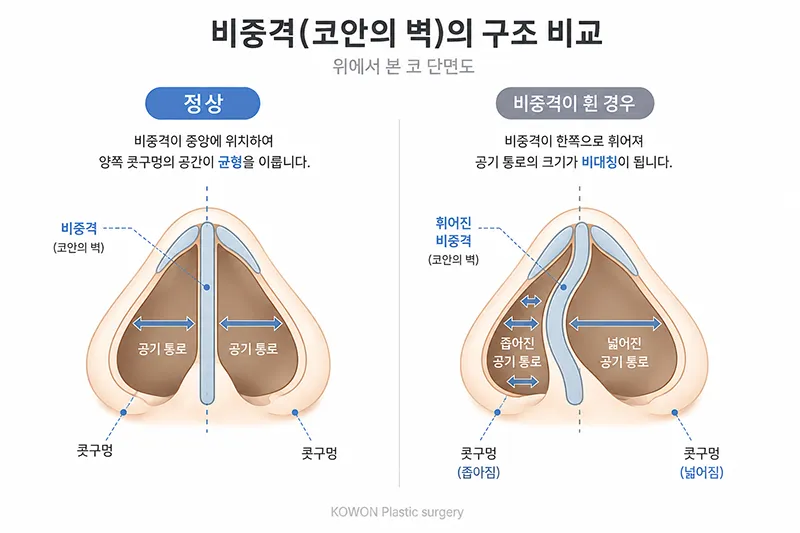
Most people with a visibly crooked nose also have deviation of the septum, the central internal wall, not just the bridge.
This wall supports the bridge’s center. If it bends, the outside looks crooked and one of the two nasal passages it separates narrows, restricting the airway.
External deviation and internal narrowing therefore often share a cause. Correcting that internal support with the crooked nose can improve both shape and breathing comfort.
But an important question is: what happens if only the exterior is improved and the internal support is left unchanged?
The crooked shape remains. (It is still crooked externally too.)
The reverse is also true if only the inside is corrected without addressing the exterior. Crooked-nose correction must consider external bone and cartilage with the internal septum,
but consultations focused only on cosmetics may leave breathing problems untreated,
while function-only treatment may leave appearance unchanged.
There is also a limitation to explain in advance: everyone has some facial asymmetry.
In some pronounced crooked noses, asymmetry extends beyond the nasal bones, from the bony base beneath the nose across the facial skeleton.
Even after straightening the nose, the supporting facial-bone asymmetry, long-standing habits and side-to-side muscle differences remain.
The nose may therefore tend to shift gradually back toward its original direction over time.
This is a limitation from the surrounding facial conditions remaining unchanged despite nasal correction, rather than necessarily an error in surgery.
With clear facial-bone asymmetry, I believe this should be explained before surgery and realistic expectations discussed together.
Also, not all nasal obstruction is caused by a crooked nose.
Some have breathing difficulty from other causes, such as rhinitis or sinusitis. Straightening the nose may then make little difference to obstruction itself.
Preoperative examination must establish whether a deviated structure causes the obstruction. If that is not the cause, breathing may not improve as expected.
In summary, a crooked nose and obstruction often share the cause of a deviated internal support, so appropriate correction can improve both appearance and breathing.
If the facial bones are clearly asymmetric, however, begin with the possibility of some return over time in mind,
and ask at consultation both whether your obstruction comes from the crooked nose and how asymmetric your facial bones are.
— Dr. Kim Hyung-taek, Director of KOWON Plastic Surgery