
It requires more than raising and supporting the tip: the downward force must be overcome and the correction maintained long term.
In an arrow-shaped nose, the cartilage supporting the tip may be positioned downward,
or an overdeveloped septal cartilage often keeps pushing the tip downward.
Alternatively, muscles that lower the tip keep acting during speech, smiling or expression, pressing it downward.
Even after surgically raising the tip, skin and tissue that have long drooped downward remain under forces tending to return them to their original direction.
Simply changing position therefore often allows drooping to recur over time. This is the main reason correction is considered difficult.
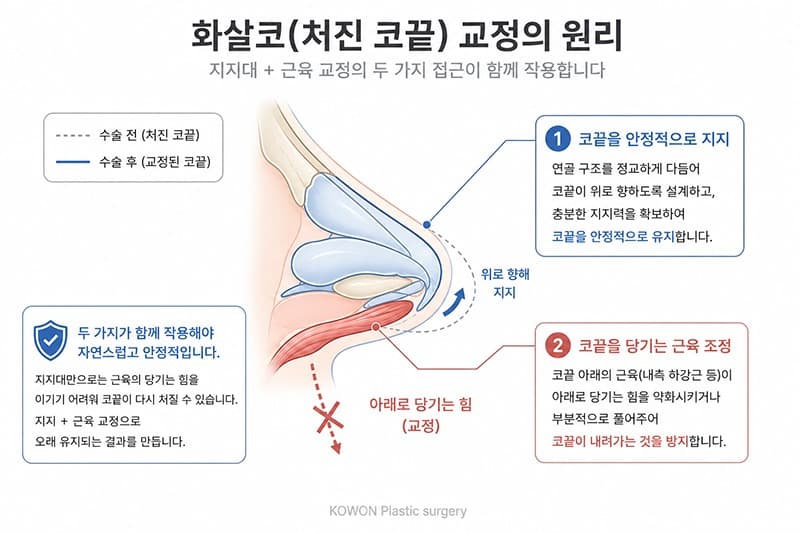
In particular, I mentioned the muscle that pulls the tip downward;
it pulls down the tip whenever you smile or speak, and its action is often particularly strong in people with an arrow-shaped nose.
If only the tip cartilage is corrected and this muscle is left unchanged, the support must resist its pulling hundreds of times a day for life on its own.
I have often seen even strong supports gradually droop again over time because they cannot withstand the muscle’s daily repeated force.
I therefore consider correcting this muscle as important as building support in arrow-nose correction.
Support material matters too. Soft, weak material may fail under the force and become distorted. Fairly strong cartilage is needed to resist the force tending to return the tip downward.
That is why I recommend your own rib cartilage, or at least donor rib cartilage.
Another problem arises if the angle used to raise the tip is wrong.
Too much elevation exposes the nostrils unnaturally; too little leaves the arrow-shaped nose unchanged.
That angle is chosen with the philtrum and upper-lip angle—the nasolabial angle—in mind, not from the tip alone.
In summary, correcting an arrow-shaped nose is difficult because support, muscle and angle must all be balanced together.
— Dr. Kim Hyung-taek, Director of KOWON Plastic Surgery