
I am often asked which material is best. The answer is that no material is best for every nose.
If there were, all doctors, including me, would use only that. Bridge materials broadly divide into silicone and your own tissue; they are good choices only when their properties suit your skin thickness and nasal condition.
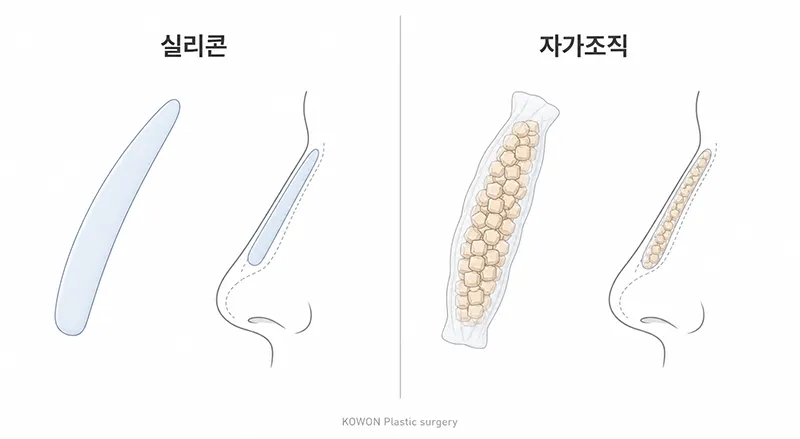
Silicone has the longest history among bridge materials. Decades of use have revealed its advantages and disadvantages, which is itself an advantage.
It is easy to shape precisely, making a smooth, defined bridge line, and can be cleanly removed if problems arise.
The drawback is that a high implant under thin skin may show its contours or cause further thinning over time.
For silicone, the result depends less on the material itself than on how low and thin it is shaped to suit that person’s skin.
Autologous tissue means building the bridge from your own body, using dermis or cartilage.
One misconception is that a whole piece of cartilage is carved like a rod and placed on the bridge. That is not the method.
Whole cartilage tends to warp, so it is processed into small particles, wrapped in fascia or formed into an implant before use.
Your own tissue has the least concern for foreign-body reactions, resists infection and places less burden even on thin skin.
However, the line is less sharply defined than silicone, and some volume may be absorbed because of the tissue’s properties.
My principle is therefore: always your own cartilage for the tip, and a choice based on the nose’s condition for the bridge.
The tip moves and takes pressure, making it unsuitable for synthetic implants,
whereas silicone or your own tissue is chosen for the bridge according to skin thickness, desired height and line, and whether it is revision surgery.
Thin skin or a history of inflammation favors your own tissue. If skin support is adequate and a defined line is desired, silicone is also a good option.
In over 20 years of nasal surgery, I have found problems arise more from unsuitable material used in an unsuitable way for that nose than from the material alone.
The issue is not silicone itself, but high silicone beneath thin skin.
When preparing for consultation, do not choose a material name first. Ask how each would differ in outcome for your skin thickness and nasal condition.
After that explanation, the material choice follows naturally.
— Dr. Kim Hyung-taek, Director of KOWON Plastic Surgery