
As mentioned previously, implant use in the tip has become much less common.
These symptoms persist because of excessive correction rather than the material itself.
If the tip is raised beyond what it can tolerate, the skin must remain stretched even when your own cartilage is used.
Tip skin is thinner than bridge skin and stretches and contracts with each expression.
Over-elevating the tip beyond that nose’s capacity leaves the skin under constant tension after surgery.
Just as prolonged overstretching harms muscles or joints, constant skin tension can impair ongoing blood flow,
initially causing redness; if it does not improve, the skin gradually thins.
Of course, some tip redness can also occur during normal early healing as the skin stretches.
This develops gradually over months to years, so a nose may look attractive immediately after surgery and show problems much later.
There is a point patients often confuse here.
Tip redness often prompts people to suspect inflammation or allergy and seek antibiotics or ointment, but most such cases are a tension problem rather than inflammation.
(Of course, persistent tip tightness does make minor inflammation more likely.)
Medication cannot readily solve the underlying problem while the excessive tension remains.
For the same reason, naturally thin skin limits how far the tip can be raised.
A height that looks natural with thick skin can be excessive for someone with thin skin.
At consultation, I first ask whether the skin can tolerate that height for years, rather than focusing on the requested elevation.
That may involve different criteria from a tip that looks attractive immediately.
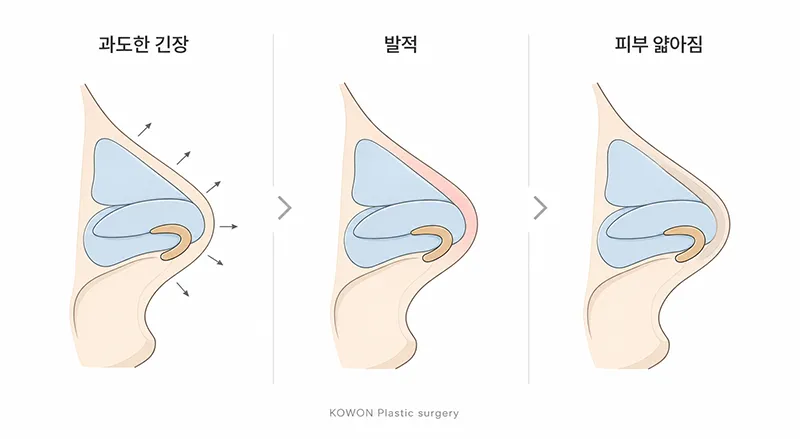
For those already affected, I want to stress that skin thinning progresses as time goes on.
It rarely improves on its own. If the tip is red or the skin feels thinner, I recommend promptly checking the cause rather than waiting.
Early revision to reduce tip tension allows recovery in most cases, but delay increases the scope of treatment needed.
In revision consultations, I sometimes meet people who have endured tip redness for years before seeking help.
A problem that could have been simple early on has grown with delay.
I want to stress that warning signs at the tip should be checked promptly by the clinic that operated on you, rather than endured and watched.
— Dr. Kim Hyung-taek, Director of KOWON Plastic Surgery