
I am often asked in clinic why silicone can be used in the bridge but not the tip.
The answer is simple: bridge and tip are completely different environments.
At the bridge, the implant rests still on firm bone. It does not move or get compressed.
The tip, however, moves countless times daily. Smiling, speaking, washing and touching the nose repeatedly press and push it.
Consider how often you touch your nose or tip. Have you unconsciously scratched it even while reading this?
Moreover, tip skin is thinner and more tightly stretched than bridge skin.
What happens with a rigid implant here? Its end keeps pushing the thin skin outward from within.
Constant pressure gradually thins the skin. First the tip reddens, then the skin looks pale and translucent; in severe cases the implant breaks through.
There was a time when L-shaped silicone joined bridge and tip in one implant.
Surgery was simple, but recurring tip-skin thinning and upturning years later led to this method falling out of use.
In over 20 years of nasal surgery, I still see people returning late for revision after operations from that period.
The implant itself was not bad; it was placed where an implant should not be.
Recently I also sometimes see synthetic mesh used in the tip.
Those using mesh explain that it is a thin woven membrane, softer than rigid silicone, with tissue growing into its openings to help it settle.
I do not use it in the tip. Softness does not remove the pressure on the tip, and it is fundamentally a synthetic material, like silicone.
I consider it only a difference in softness, with similar problems potentially developing over time.
This is my opinion. Doctors using mesh in the tip likely have their own evidence and experience; I am not declaring the material invariably bad.
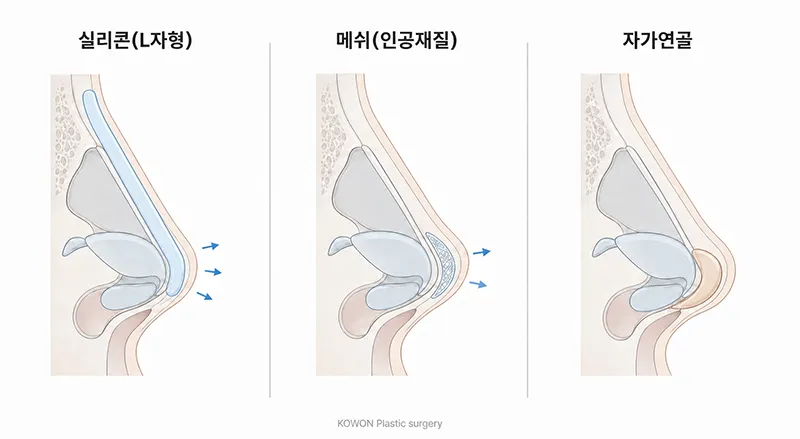
I now raise the tip with a support made from the patient’s own cartilage, a tissue naturally present in the body.
As tissue of the same nature, it does not attack the skin and can move to some extent under pressure while retaining its shape.
Septal, ear or rib cartilage is chosen according to the support needed. The choice depends on the desired tip elevation and the nose’s available cartilage condition.
Some arrive having been told that extending an implant to the tip simplifies surgery and speeds recovery. That is true: surgery becomes simpler.
Mesh can shorten surgery by more than 30 minutes.
But the price of that simplicity is paid by the tip skin years later, rather than immediately after surgery.
I believe surgery should be judged after 10 years, rather than the following month.
To sum up:
The bridge allows a choice of materials; the tip does not.
Whichever clinic you consult, always ask what will be used to raise the tip.
— Dr. Kim Hyung-taek, Director of KOWON Plastic Surgery