
The previous article discussed a muscle that pulls the tip down during smiling. Alar widening when smiling works on a similar principle.
The muscle involved is different, however.
Beside the upper lip and outside the alae is a muscle that lifts both during smiling.
When it contracts, the upper lip rises and the alae are pulled outward and upward, spreading them.
This is normal smiling movement, but if the muscle acts particularly strongly, the alae spread widely to the sides, making the nostrils look larger and the nose broader than at rest.
This explains most cases where the nose looks fine in ordinary photos but especially large in a broad smile.
This must be distinguished from a bulbous nose or inherently broad alae.
A bulbous nose looks blunt and wide even at rest because of tip cartilage or skin fat. Alae needing reduction are themselves broad even at rest.
Here, by contrast, the alae are within a normal range at rest and temporarily spread only during smiling because of muscle action. It is a movement issue rather than a structural one.
The approach differs: persistently broad alae call for alar reduction, whereas spreading only during smiling calls for reducing muscle action rather than the alae themselves.
Recommending alar reduction from resting photos alone without that distinction leaves the smiling-related spread unresolved.
Conversely, addressing only muscle in someone whose alae are actually broad may not produce the desired change.
I therefore always ask patients to smile at consultation and compare resting and smiling appearances side by side.
Both often coexist: slightly broad alae at rest become much more noticeable when muscle action is added during smiling.
These patients need consideration of both reducing alar width and adjusting muscle action.
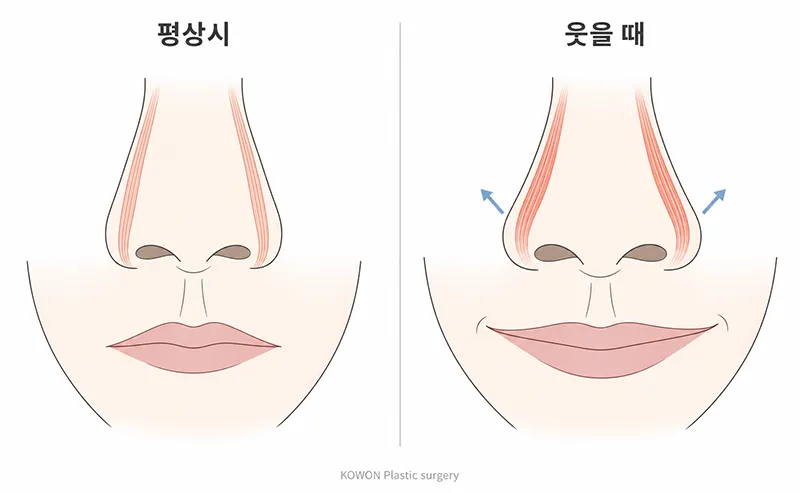
The nose is strongly affected by facial-expression muscles, and its shape differs at rest and in motion. A single frontal consultation photo shows only half the picture.
If the alae concern you particularly when smiling, begin consultation by distinguishing an alar issue from a muscle issue.
If unsure, look in a mirror now and give a broad smile.
— Dr. Kim Hyung-taek, Director of KOWON Plastic Surgery
More about nasal-tip muscle correction: https://kowonps.com/nasal-tip-correction?wvd=1