
This is especially common among people whose noses were large and had abundant tissue to begin with.
This is often less about an error in surgery than disappointment from not recognizing that this type of nose needs a different approach from the start.
With a large, tissue-heavy nose, people think removing a lot will clearly make it smaller. That is understandable.
It seems natural that removing more tissue would reduce size proportionally. Some soft tissue or flesh is indeed removed.
But removing as much as expected is difficult. In a large, thick-tissued nose, excessive removal of flesh or skin
can strain the local blood supply and supporting structures, increasing the risk of uneven contours or unexpected deformity during healing.
The larger the nose, therefore, the more conservative removal should be, with other methods addressing the rest.
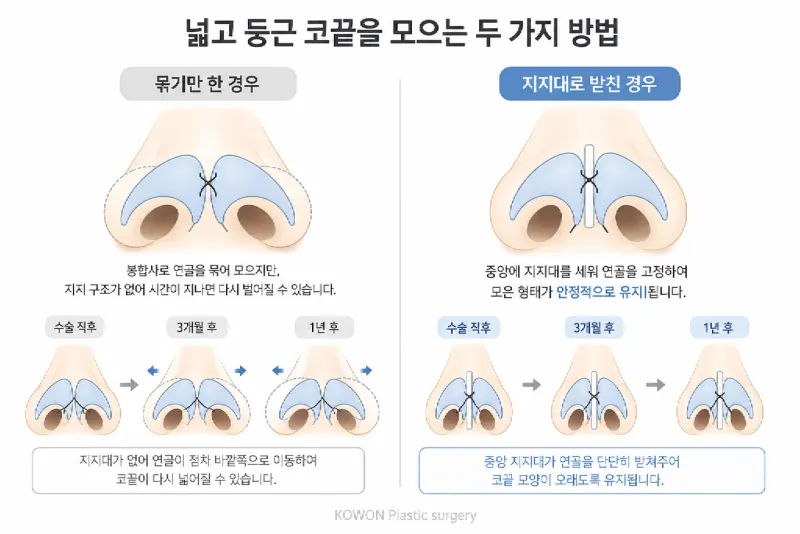
That method gathers the broadly spread tip tissue toward the center and raises it.
A nose often looks broad and large because of its spread shape more than its actual volume.
Crucially, even after gathering it, the weight of skin and tissue can cause drooping or spreading again over time.
If cartilage is merely gathered with sutures, the knots may loosen over time or the tissue may be pulled gradually toward its original spread shape.
Suturing alone is therefore not enough; a strong central support must structurally maintain the gathered shape.
Noses sutured without support often look good for the first few months but seem to spread again later. This is usually also a support issue.
For the same reason, rib cartilage may be used from the start in severe bulbous noses to support the tip well.
Finally, there is one more point to assess together.
I previously discussed muscles that make the alae spread when smiling. Their involvement must also be assessed when gathering and raising the tip.
Even a well-gathered, supported tip may gradually spread again if muscles keep pulling outward during smiling or expression and the support cannot resist that force.
When muscle effects are strong, addressing them too is needed for a lasting result.
— Dr. Kim Hyung-taek, Director of KOWON Plastic Surgery
Here is a related article.
Q. 웃을 때 콧볼(콧방울)이 유독 퍼져 보이는데 이것도 근육 때문인가요? : https://www.kowonps.com/nose_qna/8