
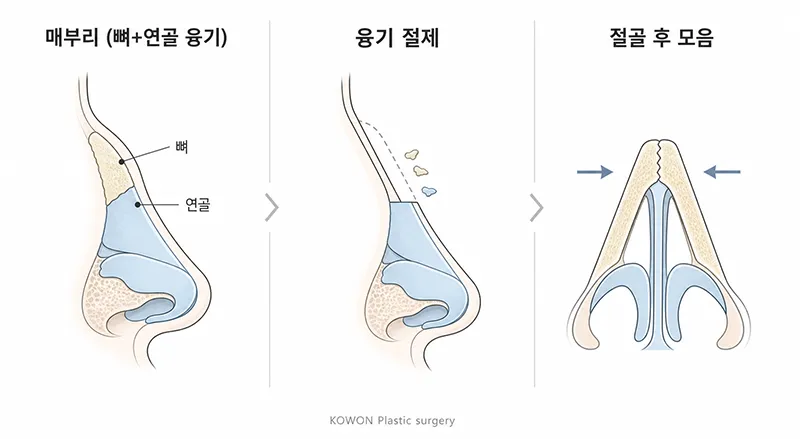
Only partly. Most humps involve both protruding bone and cartilage, so shaving bone alone may leave a convex profile.
Hump correction is better understood as refining the entire prominence for a smooth bridge, rather than simply shaving bone.
Some have more prominent bone and others more cartilage, so focusing on only one can leave an unsatisfactory result.
The proportions differ by nose, so this is decided after direct assessment at consultation, with CT.
You may wonder whether every hump correction is a major bone-removal operation. It is not.
A mild hump can often be smoothed sufficiently by rasping the protruding area alone.
With a large hump, or if rasping would leave a broad bridge, the nasal bones on both sides are also brought slightly inward.
Not every hump requires the same extent of surgery; only what its severity calls for is done.
Ask which category applies to you at consultation for an accurate answer.
Another easily missed point is that people with humps often also have a long, drooping tip.
Refining only the bridge in these noses leaves it out of balance with the tip.
Hump surgery therefore must assess the full bridge line, especially its proportions with the tip, not just the dorsum.
Asking how proportions with the tip will be balanced is much more useful than asking whether the dorsum only needs shaving.
Finally, I would like to mention a recent change.
Previously many preferred humps smoothed as much as possible into an almost straight line. Preferences are different now.
More people want a less artificial-looking bridge, leaving a subtle natural curve instead of removing every small contour.
I agree with this change to some extent,
since a perfectly straight bridge can look more obviously operated on, while a slight curve often blends more naturally with the face.
Rather than aggressively shaving the prominence, raising what droops and balancing height from the nasal root can look more natural.
There is no longer one right answer to how smooth the result should be, and patient satisfaction has increased too.
— Dr. Kim Hyung-taek, Director of KOWON Plastic Surgery