
Previously I explained that bridge materials broadly divide into silicone and your own tissue.
But the broad term ‘autologous-tissue rhinoplasty’ covers several methods with substantially different results.
Many arrive knowing only that they chose their own tissue, but which tissue is used and how it is processed differ greatly.
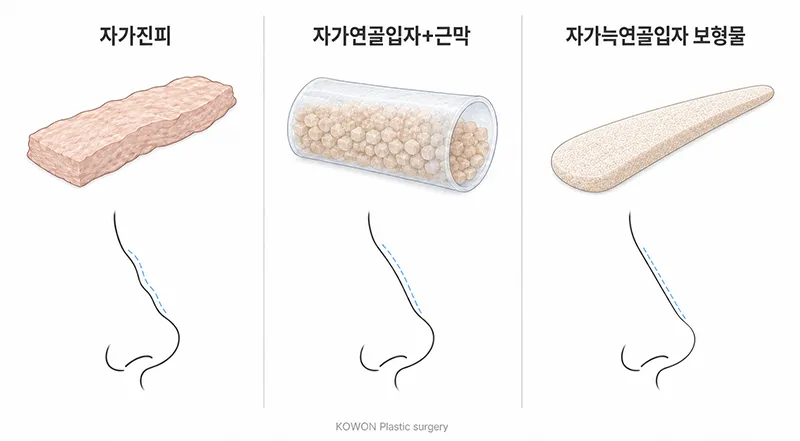
Autologous dermis takes the dermal layer from your body and places it in the bridge. It clearly has the advantage of being your own tissue, but I generally do not recommend it for the bridge.
There are two reasons: dermis is thick and blunt, making a precise bridge line difficult, and above all its absorption rate is hard to predict.
Absorption varies between patients; even within one patient, uneven absorption can make the bridge irregular.
If the operation went well but results vary, that is a material limitation rather than the surgeon’s hands.
Autologous cartilage particles with fascia use finely diced cartilage wrapped in fascia for insertion.
Think of filling fascia with cartilage particles like rolling gimbap.
Absorption is less than with dermis but still must be allowed for. Its soft pouch shape also limits precise lines.
Patients may not know that absorption varies with how finely the cartilage is diced and how densely it is filled.
Standards differ by clinic, explaining different results even under the same ‘cartilage-particle bridge’ label. Separate fascia harvesting adds another burden.
An autologous rib-cartilage particle implant is made by processing rib cartilage into particles and compressing them into a bridge-shaped implant for insertion.
The material remains your own cartilage, but its form is precisely shaped like an implant.
Particle processing determines the result. Finer particles allow more cartilage to be densely compressed into the same volume; denser tissue has a lower absorption rate.
I mentioned particle size as a reason cartilage-particle results differ by clinic; the same principle works in reverse here.
How finely particles are processed and how densely they are packed determine the quality of this operation.
This approach combines two previously hard-to-reconcile goals in one material: autologous-tissue integration and safety, and an implant’s precise line.
Frankly, when I thought of this method again, it felt like a eureka moment.
It had been used mainly at university hospitals. After over 20 years of balancing silicone’s precision against the safety of one’s own tissue, I found an answer here.
At the time, I was struggling with how to operate on a patient from overseas who had an autoimmune disease.
I still remember how I felt when I realized I could use it for my patients.
Today there are many mold manufacturers and sales visits, but when I started, these were unavailable, so I had to ask around and find what I needed.
We therefore make this method central to bridge surgery under the name RibFit.
It is not a cure-all. Harvesting rib cartilage requires a small chest incision, and particle processing and implant fabrication add substantial work beyond harvesting.
I too have used autologous rib-cartilage particles with fascia for around 10 years, but achieving today’s fine particles required extensive trial and error and time.
There is no reason to use it for noses needing only slight bridge elevation, or with thick, strong skin where silicone is enough.
As stated previously, the nose’s condition determines the material, not the clinic.
However, if your skin is thin, you have had inflammation or contracture, or you dislike synthetic implants but do not want a blunt bridge,
be sure to confirm which autologous-tissue method is being proposed before deciding.
The label ‘autologous tissue’ does not mean all the operations are the same.
— Dr. Kim Hyung-taek, Director of KOWON Plastic Surgery